
The Scoreline and the Shot Quality Are Not in Agreement
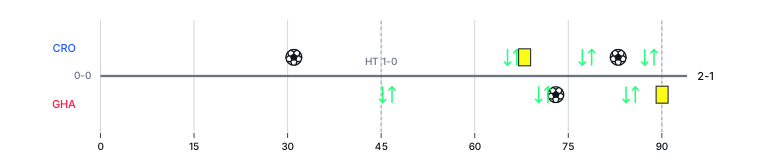
Sučić's 31st-minute opener carried an expected-goals value of roughly 0.04. Vlašić's header from a corner in the 83rd came in around 0.05. Two goals, 0.42 cumulative expected goals for Croatia across eight shots — the result and the underlying chance quality are operating on different registers, and that gap is the honest shape of this match.
Ghana ended the afternoon with a negative goal margin and a positive chance quality margin. The single highest-quality opportunity of the game was Luckassen's set-piece equalizer at 0.61 — more than the combined expected-goals value of both Croatian goals. Croatia held a slim shot-volume edge, eight to six, and struck the woodwork once. Those are real structural contributions to the scoreline. But both winning goals came from the low-probability end of the chance map, and Croatia registered zero big chances across ninety minutes.
The limitation here is worth stating once and not repeating: this is a result-profile observation, not a fairness verdict. Football does not settle results according to shot quality within a single game. What it does settle is who converted, and Croatia converted at a rate that bears no relation to how their shots were falling. Ghana's failure to make their better opportunities count is a football reality. It is also the primary reason a match where Croatia never created a big chance finished 2-1 to Croatia.
Nuamah's Nineteen Minutes Produced More Than Most Players Manage in Ninety
Nuamah entered at the 71st minute. Luckassen had headed Ghana level by the 73rd. That compression — substitution to goal in two minutes — is where the match briefly corrected itself against the underlying chance quality.
The record behind that sequence is specific. Nuamah registered two key passes and an assist across his nineteen-minute cameo. The chance he created for Luckassen carried an expected-goals value of 0.61, the highest-quality opportunity either side produced all afternoon. By key passes, by assist, by the quality value of the chance he delivered, the output was immediate and measurable — not a substitute who warmed the match without touching it, but one whose involvement in the final third produced the afternoon's clearest goalmouth moment.
The evidence is also clear about what it cannot establish. A two-minute substitution-to-goal sequence documents a sequence, not a causal mechanism. There is no tracking record of what Nuamah did differently from the player he replaced, no evidence of a specific matchup advantage, and no basis for wider claims about what his entry structurally altered. What the record supports is that Nuamah, in the time available, created end product at a rate that made his cameo the most concentrated creative burst in the match. The equalizer at 1-1 was his assist. The chance value was his creation. That is sufficient to judge.
A One-Goal Lead With No Shot Output Is Thin Cover
From the 46th to the 60th minute, Croatia produced no shots. Ghana produced two. The volume gap is modest — two against zero — but the directional fact is not: across the opening quarter-hour of the second half, one side was generating attempts and the other was not.
The score state made that fifteen-minute window consequential in a way the numbers alone do not fully capture. Croatia were protecting a one-goal lead with no offensive output to ease the pressure. A side can absorb attempts and still maintain a lead, but the margin for error narrows when the only activity is defensive. Ghana's two shots in that phase carried a combined expected-goals value close to nothing, so the danger was limited — but the absence of any Croatian reply meant the game's direction of travel pointed one way for those fifteen minutes.
Provider momentum signals across this window were mixed in direction and carry unverified semantics; they support the shot-gap picture as context rather than proof of territorial dominance. The shot record is the reliable evidence: Ghana were the only side attempting anything during that stretch. That the phase closed without a Ghana goal owed something to finishing and something to the defensive clearance burden Croatia carried — 23 across the full match. When Nuamah arrived at the 71st minute, he was not entering a match that had settled. He was entering one that Ghana had been pressing toward.
Croatia's Width Was Recorded. What It Caused Is Less Clear.
Martin Baturina's average position across the match placed him high and wide on Croatia's right — in the attacking half, pushed to the flank rather than condensed centrally. Josip Stanišić, at right-back, sat deep on the opposite side of the pitch but stretched wide of center in horizontal terms. Croatia's team shape recorded nine players averaging in the attacking half, with seven through the center lane and four on each flank.
The picture that emerges is one of horizontal spread on the right side. Baturina and Stanišić's recorded positions are the clearest markers: both registered wider than a side clustering exclusively through the center would produce, and five Croatia players in total were tagged as occupying high and wide zones. This is not a trivial observation — a team with genuine width on the right occupies Ghana's defensive attention differently than one that narrows everything through the middle.
The constraint on what this tells us is real. Average positions describe where players spent most of their time across ninety minutes; they do not capture how the shape shifted between phases, what it looked like during Croatia's defensive spells, or whether the width reflected specific instructions or the natural drift of those positions over a full match. Claiming Croatia built their win through right-side width, or that the width was structurally deliberate, would exceed what this evidence can support. The recorded positions show width. What the width produced on the day is a harder argument to make from averages alone.
Synthesis
Two goals from 0.42 expected goals is a real number. So is the -0.31 xG margin. So is Luckassen's 0.61 — the single best chance of the afternoon, converted two minutes after Nuamah stepped off the bench. These are not competing stories that politely disagree with each other; they are the same match seen from different angles, and the full reading requires holding all of them without letting one collapse into the other.
Croatia were efficient. The word is descriptive, not congratulatory — they converted what they were given, including two chances at the low-probability end of the map, and the result reflects that conversion. Ghana had the better opportunities, pressed the early second half in shot terms with Croatia offering no response, and equalized through the most productive nineteen-minute cameo in the match. That the game did not finish 1-1 is because Vlašić headed home from a corner at the 83rd minute, another low-probability finish from another set-piece situation.
What this match exposes is the gap between the responsibility of creating chances and the separate, unreliable business of converting them. Ghana created better. Croatia converted better. The right-side spacing that Baturina and Stanišić recorded across the afternoon contributed to Croatia's territorial picture without clearly explaining either goal. The points went to Croatia. The underlying match required a specific kind of finishing fortune to produce that margin, and the scoreline carries rather less authority than the result table will suggest.