
Two Changes, One Turning Point
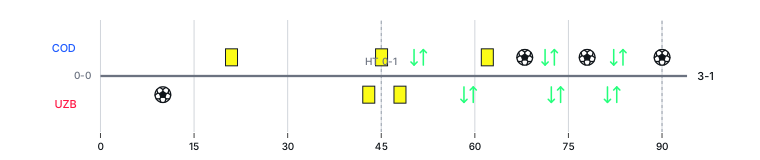
Fiston Mayele came on at 51 minutes and changed what DR Congo were asking of their forwards. Bakambu had led the line through the first half while DR Congo trailed; Mayele arrived with different physical properties and an immediate presence in the shot sequence. In the 15 minutes following that change, DR Congo produced five shots worth 0.4 in chance value — a noticeably sharper return than any comparable earlier window. Mayele himself scored in his 39 minutes of play, and his stat line — one shot on target, 0.76 in expected value from that attempt alone — reflects how directly he converted the new focal point into threat.
The second wave arrived at 72 minutes, when three more players came on together. The most consequential was Meschak Elia for Nathanaël Mbuku. In 18 minutes of play, Elia completed all 12 of his passes, created three key chances, and delivered the direct assist for Wissa's second goal in stoppage time. The 15-minute post-72' window produced three shots worth 0.71 in chance value and the goal that closed the match at 3-1.
What the two windows share is a pattern of incoming players directly involved in the late scoring actions. The 51' change introduced a new attacking reference point; the 72' cluster added delivery and movement that Uzbekistan's defense had not seen from the earlier lineup. Neither substitution transformed a losing game into a comfortable one — DR Congo had been the more threatening side throughout — but together they concentrated the match's decisive output into its final half-hour. The scoreline moved from 0-1 to 3-1 inside that span. The bench was the mechanism.
Wissa Did What the Structure Required
Yoane Wissa scored twice from two shots on target, and his six total attempts carried 1.3 in expected value — a number that reflects genuine chance quality, not just volume. His first goal, at 68 minutes, equalized after DR Congo had trailed since the 11th. His second, in the opening minute of added time off Elia's assist, completed the scoreline. Two goals from two on-target efforts is conversion efficiency, not accident.
Wissa played all 90 minutes, which matters for understanding his role. He wasn't a late impact substitute arriving into space — he was there throughout, absorbing defensive attention, drawing three fouls, and making three ball recoveries in phases that had nothing to do with finishing. He lost nine duels and four aerial challenges, which tells you something about the work between the goals. He also missed one big chance, which keeps the picture honest. This was a productive rather than flawless performance.
The structural point is the relationship between Wissa and the bench changes around him. Mayele's entry altered the attacking shape and created different types of runs; Elia's arrival brought precise delivery. Wissa converted the outcomes those shifts produced. He was in position to do so because he'd stayed in the game — physically present, spatially available — through the period when DR Congo were pressing without breaking through. The substitutions opened something. Wissa was the player ready to walk through it.
DR Congo's Box Access Was Already There
The late burst didn't emerge from nothing. DR Congo had been building consistent access to scoring positions throughout the match — 19 shots in total, 11 from inside the box, 2.35 in chance value accumulated across 90 minutes. That profile reflects a team that spent the afternoon finding routes into dangerous areas, not one that scraped chances at the margins and got lucky.
The chance value distribution by phase is instructive. The 61-75 window alone produced over 1.1 in expected value, reflecting the convergence of the substitutions and Wissa's equalizer. But the earlier phases had been building steadily too — DR Congo produced attempts in every period from the 16th minute onward. Fifty-eight percent possession and 63 final-third passes gave the territorial framework; 21 crosses with five accurate reflects width as a persistent route of entry, even if the delivery conversion was uneven.
The inside-box shot share — roughly 58 percent of all attempts — is the more meaningful number. This wasn't a side flooding shots from range hoping for deflections. They were finding positions inside Uzbekistan's defensive structure repeatedly. Three big chances over the course of the match, with one missed, adds a note of imprecision to what was otherwise a productive attacking map. What the late goals did was convert a profile that had been there all afternoon. The bench changes sharpened the final output; the underlying access had been established well before the 60th minute.
Uzbekistan Had No Route Back
Uzbekistan's attacking record in this match is not a gap in the data — it's the finding. Three shots across 90 minutes. Zero attempts between minutes 11 and 75. A total chance value of 0.20. Those numbers describe a side that, once they had taken an early lead, could not sustain or extend any forward threat. The 64-minute stretch without a shot is not explained by a single phase breakdown or a particularly high-block tactical shift; it's simply the absence of a functioning attacking system over most of the game.
The pass data adds context. Forty-two percent possession and 51 final-third passes meant they could circulate the ball but rarely move it into positions that demanded a response. Sixteen crosses with only two accurate tells a parallel story about delivery — they tried to use width but found no traction there. Their 38 clearances made is the defensive counterpart: the majority of what they did in this match was absorb rather than create.
The score-state context matters here. DR Congo trailed from minute 11 to minute 68 — a long stretch in which Uzbekistan were theoretically managing a lead. During that same window, Uzbekistan produced just two shots worth 0.19 in chance value. The result is that when DR Congo equalized and then moved ahead, there was no adjusted plan available; the attacking routes had never been there. The 3-1 final score reflects not just DR Congo's conversion of their chances but the completeness of the opposition's attacking failure.
Synthesis
DR Congo's performance had a coherence to it that the late scoring burst can obscure. The box access and shot volume were already established before the substitutions landed — 19 attempts, more than half from inside the penalty area, a chance value profile that outstripped the scoreline for long stretches. What the bench did was reorganize the attack's final delivery and timing, not create threat from a vacuum.
Mayele changed the focal point. Elia changed the delivery. Wissa converted both shifts. The three pieces are genuinely connected: substitute entry altered how the attack worked in its final third, and the player already on the pitch for 90 minutes was in position to finish what the changes produced. That's not a coincidence of timing — the goal events and the direct involvements confirm the chain.
Uzbekistan's position on the other end of that chain was structurally unresolvable once the scoreline turned. A team that produces three shots and nothing between minutes 11 and 75 has no late-game answer. The early lead they held didn't reflect territorial control or a chance-creation surplus — it reflected DR Congo converting their large volume too slowly. When the bench changes concentrated the attacking return, the Uzbekistan side that had never established a counterweight had no adjustment to make.
The result, then, is a fair representation of how the match behaved — not a lucky late rally, but the delayed expression of a shot map that had been there all along, sharpened in the final half-hour by exactly the right personnel arriving at the right time.