
Possession Without Consequence
Sixty-one percent possession and 587 completed passes are numbers that ask to be read as control. They are not. Egypt's ball circulation against Iran produced zero big chances, an xG per shot of roughly 0.05, and six of fifteen attempts blocked before they reached the goalkeeper. That is not a team that governed the match — it is a team that kept the ball while the match stayed largely ungoverned.
The shot profile makes the problem concrete. Seven of Egypt's fifteen attempts came from outside the box, and the eight from inside it were rarely constructed under real pressure on the back line. Corners mounted — eight in total — yet none produced a chance worth naming. Only about ten percent of Egypt's passing volume even reached the final third, which means the remaining ninety percent circulated in zones that asked nothing of Iran's defensive shape. The ball moved, the threat did not.
Possession without consequence is only politeness. Egypt accumulated passes the way a team does when it controls surface area but cannot find the seam that actually hurts. Iran's block held, the lines stayed compact, and Egypt's circulation never found the vertical pass or the entry that would have forced a real decision. The volume was there. The authority to use it was not.
Iran's Cleaner Answer
Iran did not try to match Egypt pass for pass. They did not need to. Thirty-nine percent possession, 14 shots, 1.83 expected goals, three big chances — and one of those chances converted. Against Egypt's 0.05 xG per attempt, Iran averaged better than 0.16 per shot, three times the threat on less than half the touches. That is not a coincidence of volume; it is a difference in the quality of positions reached.
The big-chance count is the clearest dividing line. Egypt produced none. Iran produced three — high-probability opportunities that demanded genuine answers from Egypt's goalkeeper and defenders, not routine collection. Iran also hit the woodwork once. The shot map shows set-piece and assisted situations among their most dangerous attempts, and their xG was concentrated at moments when the ball arrived inside the box under conditions Egypt struggled to clear cleanly.
What Iran understood was that the match did not need to be won through possession. It needed to be won through the specific moments when Egypt's defensive shape could be stressed. A midfield that governs does not simply accumulate — it chooses when to accelerate, when to commit bodies forward, when to make the opponent answer a question they have not prepared for. Iran asked those questions sparingly. When they did, Egypt had no comfortable answer.
The Reset That Changed the Personnel, Not the Problem
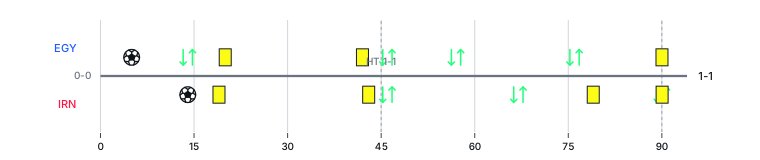
Egypt made two changes at the break — Mahmoud Saber and Emam Ashour came on for Marwan Attia and Omar Marmoush. The fifteen minutes that followed produced three Egypt shots worth 0.28 expected goals combined, and just one attempt in the immediate five-minute window after the changes, worth barely 0.07. That is not a team that has found a new way through.
The substitutions arrived into a structural problem, not a personnel one. Egypt's difficulty was not which individuals were on the pitch; it was that their circulation kept finding Iran's defensive block rather than the space behind it. Changing two players did not change the geometry of the problem. In that same 46-to-60 window, Iran produced two shots worth 0.09 xG — both teams generating little, neither resolving anything. The midfield phase was more active in shot count than some of Egypt's first-half stretches, but the quality markers stayed flat on both sides.
What the halftime reset achieved, at most, was continuity. Egypt kept the ball; Iran kept their shape. The scoreline held at 1-0 in Egypt's favor, and the underlying gap between Egypt's careful circulation and Iran's concentrated danger had not narrowed. It had simply been given different legs to carry it into the second half.
The Late Spell That Showed What the Match Actually Was
From the 76th minute onward, Egypt produced one shot worth 0.04 expected goals. Iran produced six worth 0.94. The match, which had looked capable of holding at 1-0, did not hold.
Shoja Khalilzadeh scored from a set piece in the third minute of added time. In the minutes immediately surrounding that goal, Mohammad Ghorbani's attempt was saved, Saeid Ezatolahi's corner-kick header struck the post — a chance worth roughly 0.24 on its own — Ramin Rezaeian was blocked, and Mehdi Taremi missed. Five shots, five different ways the scoreline nearly changed further, in a matter of minutes after Egypt had held the lead for most of ninety. Iran's late-game substitution at minute 90 coincided with the window that produced all five of those attempts, though timing alone does not explain the concentration of danger.
This is what the final 1-1 compressed into one number. Egypt's defensive structure, which had held for most of the contest, faced the most sustained and highest-quality pressure it had seen at exactly the moment the match was closest to being decided. The post, the save, the block, the miss — each was a different result that did not arrive. Iran equalized and came measurably close to winning outright. Egypt's response in those final minutes was one forgettable attempt. The score says level. The match said something rather different.
Synthesis
The 1-1 is not an injustice. But it is not an accurate portrait either.
Egypt governed the surface of this match — the possession share, the pass count, the corner tally. None of it produced a big chance. Their ball circulation was precise enough to maintain control of the minutes in between the dangerous moments, and inadequate to manufacture any dangerous moments of their own. The halftime changes brought fresh legs into that same structural constraint, and the fifteen minutes that followed confirmed the problem was not personnel.
Iran made different choices. They ceded the ball and waited for the positions that mattered. Three big chances, 1.83 expected goals, one goal scored, one header off the post, a saved attempt, a blocked shot, a miss — all of that in a match where Iran held possession for barely a third of the time. The stoppage-time spell did not come from nowhere; it was the concentrated version of what Iran had been doing all afternoon, now applied with Egypt defending a lead and running short of ideas.
Who accepted responsibility for the game? Egypt accepted responsibility for the ball. Iran accepted responsibility for the moments that decided whether the game was won or drawn. The scoreline averaged those two separate games into one number, and in doing so, it flattered Egypt and slightly undersold Iran. The draw is the result. The process is a different story entirely.