
Seven Shots Before New Zealand Had Anything
Belgium didn't ease into this game. In the opening 15 minutes they produced seven shots worth just over 1.0 in expected goals while New Zealand managed zero. That is not a contest that gradually tilted — that is one team in the attacking zone forcing attempts while the other has no foothold in the match at all.
Seven shots before the quarter-hour mark tells you something concrete. These were not speculative efforts from range — a 1.0 xG return on seven shots means Belgium were finding positions where the goalkeeper and defense were genuinely threatened. The chance value confirms what the shot count suggests: Belgium were in the right places, early.
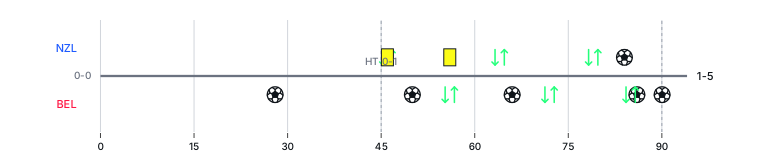
What that opening spell created was a structural platform. Belgium already held a meaningful xG lead before the game had settled into any rhythm. The provider momentum signal in this window corroborates the pressure Belgium exerted, though that record is context rather than a precise tactical explanation. The phase data is the evidence: one team generating danger repeatedly, the other producing nothing in reply. Belgium kept that output coming until Trossard's goal arrived at 28 minutes and the scoreboard finally caught up with what the shot map had been showing for nearly half an hour.
The Shot Map Never Corrected
The 7-0 opening didn't define a ceiling — it confirmed a direction. Belgium sustained that chance-creation edge across the full 90 minutes: 35 shots, 10 on target, and 3.65 expected goals on 55% possession. The xG gap over New Zealand was 3.4. The result profile lines up on every available signal — shot volume, big-chance count, and shot-on-target share all point the same way.
The inside-box figure is the number to hold onto: 23 of Belgium's 35 shots came from inside the penalty area. That is not a team launching crosses and hoping. Belgium were repeatedly reaching positions where goals are actually scored. New Zealand's goalkeeper made five saves; two of Belgium's four big chances went begging. Even the misses came from spots that mattered.
Fifty-five percent possession is not dominant by high-control standards, and Belgium weren't hoarding the ball. They were moving it directly enough into the final third — 50 passes into that zone on 88% accuracy across the game — to keep the attack generating. The shot profile reflects that: Belgium's xG was distributed across every phase of the match, with the early window being the sharpest but no 15-minute block going quiet. This was chance creation through sustained access, and it ran for the full contest.
Vanaken's Job Was to Keep the Forward Pass Alive
Someone has to decide when to play through the line. In Belgium's build, that was Hans Vanaken. Seven key passes across 90 minutes — passes that directly created a shooting opportunity for a teammate — is not "he was involved a lot." Seven means he was repeatedly reading the moment when the forward pass was actually on and executing it under pressure.
The stat line is specific: 50 accurate passes from 51 attempts, one assist, and one big chance created. The assist is the concrete marker — a direct contribution to a goal. The big chance created means at least one of his deliveries reached a position where scoring was the expected outcome, not just a hopeful ball into traffic. His 0.44 expected assists across the match reflects how often his passes put teammates into genuine shooting situations.
Vanaken also won five ball recoveries and lost possession only three times in 61 touches. That combination — a player who plays forward often and gives the ball away rarely — is what keeps a chance-creation system generating output rather than resetting after turnovers. He was tagged as both a creator and a defensive worker in the match, and both parts show in the numbers. Belgium's sustained shot volume across all 90 minutes had Vanaken's decision-making running through the middle of it.
Corners Were a Separate Route Entirely
Eight corners gave Belgium eight re-entries into the dangerous zone from a dead ball, bypassing whatever shape New Zealand had set. That volume produced five shots and 0.83 expected goals from corners alone — a meaningful parallel lane to the open-play creation Vanaken and the rest were generating.
Trossard's goal at 28 minutes came directly from a corner. The shot carried an xG of around 0.5 — one of the cleaner chances Belgium created all game — and it was a right-foot finish from close range that made the score 1-0. That single corner delivery produced a high-value chance and it went in.
Seventeen minutes later, Arthur Theate connected with a header from another corner just before halftime stoppage time. He missed, but Belgium were still working the same lane, still earning corners, still generating situations where an aerial threat arrived in the box. New Zealand had to deal with all eight corners across the match and the shots they produced. The 0.83 xG from that set-piece lane is a real addition to Belgium's open-play output — not incidental volume, but a second route that ran continuously alongside central creation and contributed directly to the scoreline.
The Bench Arrived at 85 and Finished It
Belgium brought on Romelu Lukaku for Charles De Ketelaere and Nicolas Raskin for Youri Tielemans at 85 minutes. The match was already settled. What followed in the final minutes turned a controlled win into a 5-1.
One minute after entering, Lukaku scored at 86 — Raskin with the assist. Then in the fourth minute of added time, Lukaku turned provider: his pass set up Alexis Saelemaekers for the fifth goal. In 11 minutes of playing time, Lukaku produced a goal and an assist, and the shot he scored carried 0.52 expected goals — a high-value opportunity, not a situation that fell to him by accident.
In the five-minute window following those substitutions, Belgium produced five shots and two goals from 0.68 combined xG. That is conversion above expectation in a very short burst. Whether the substitutions directly caused the goals is harder to establish — the score was already lopsided and the game was stretched. What the sequence shows clearly is direct involvement: Raskin assisted within a minute of entering, Lukaku scored, then assisted the fifth. Both players went into the action immediately and made the key contributions. Belgium had enough quality on the bench to add a goal and an assist within minutes, which says something real about the depth of the chance-creation system that had been running all game.
Synthesis
Belgium's 5-1 was not one mechanism that held for 94 minutes. It was several running at once, each with a different trigger, each adding to the total in ways the scoreline compresses but doesn't explain.
The opening 15 minutes set the terms — seven shots, just over 1.0 xG, New Zealand with nothing — before the game had found any shape. Vanaken's distribution kept the engine running through the full 90, finding the forward pass seven times in a way that created direct shooting situations. When open play temporarily stalled, the corner lane was already operating: eight corners, five shots, 0.83 xG, and Trossard's opener at 28 minutes as the first concrete return. Then the bench arrived, Lukaku and Raskin combining for a goal within a minute of entering, and Lukaku assisting the fifth in added time.
Each piece connected to the next. The early volume established a lead that gave Belgium the platform to keep attacking rather than manage. Vanaken's distribution sustained the shot rate through the middle phases. The corner lane added a separate threat New Zealand had to defend alongside open play. And the late substitutions found a match already tilted far enough that two new players could step straight in and convert immediately. Take any one layer away and the total shrinks. Put them all together and the 5-1 is exactly what the process earned.