
Bellingham as the Hinge England Needed
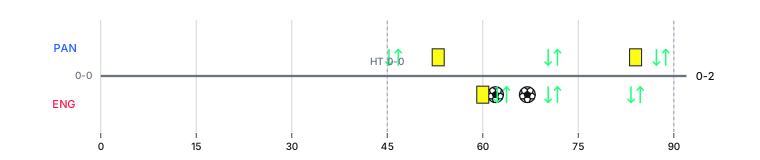
Jude Bellingham did not simply appear at the right moments — he engineered them. His goal at 62 minutes, finished after Bukayo Saka's delivery, opened the scoring. Five minutes later he turned provider, threading the assist for Harry Kane to make it two. That five-minute stretch settled a match that had been goalless and somewhat becalmed for an hour.
What made Bellingham's contribution structural rather than opportunistic was the breadth of it. Across 71 minutes he completed 37 of 43 passes, created four chances, and won 11 of his 17 ground duels. Two of those chances were classified as big. He also recovered seven balls and tackled four times successfully — the kind of defensive accounting that keeps a central player from being a liability when possession turns over. The role was not a luxury position; it was a load-bearing one.
The provider rating of 9.3 reflects the output rather than explaining it. What the numbers show is a player who operated in central areas with enough volume — 68 touches, four attempted dribbles, three completed — to pull Panama's defensive structure into constant adjustment. Whether that adjustment was what created the seams for both goals cannot be proven from the record alone. What is clear is that both of England's scoring moments ran directly through him, and that no other England player came close to matching that combined attacking and defensive footprint in the time he was on the pitch.
Control Had a Shape, and That Shape Leaned Left
England's 67% possession was not spread evenly across the pitch — it had a distinct tilt. Average positions show five England players occupying the left lane against only three on the right, with eight through the center. That asymmetry in occupation meant Panama's right side faced consistent pressure while England's right flank was relatively unthreatened going the other way. Possession figures alone rarely tell you where the game was actually being played; here the spatial shape reinforces that England's buildup ran heavier down one side.
The passing numbers add texture to that picture. With 557 passes at 88% accuracy and 68 into the final third, England moved the ball securely enough that they rarely needed to force anything under pressure. That pass security meant Panama's defending was largely reactive — absorbing ball movement rather than forcing turnovers in dangerous areas. England managed 12 of their 17 shots from inside the box, which is consistent with a team that was finding access rather than being pushed to shoot from distance.
The limit worth naming: average positions are not movement tracking, and they do not tell us whether the left-lane concentration was an explicit plan or simply where the ball kept ending up given individual player tendencies. What the record supports is that the shape existed and that England's chance-creation volume — four big chances, 1.4 in shot quality — was compatible with a team that had found reliable routes into the final third. The mechanism behind those routes leaned left, but its precise cause stays bounded by what the data can show.
Forty-Five Minutes of Patience, Five Minutes of Damage
Nothing happened in the first half — at least on the scoreboard. England produced four shots in the 31-45 window with about 0.3 in shot quality, but Panama kept the sheet clean. The match arrived at halftime with the structural imbalance fully visible and the scoreline stubbornly level. England had the possession, the shape, and the better chances; they did not yet have the goal that would change what Panama could do defensively.
The second half flipped that quickly. Between minutes 46 and 60 the game stayed goalless — England created a couple of moderate opportunities, Panama barely tested — and then the 61-75 window turned decisive. Two England goals inside five minutes from three shots worth around 0.4 in quality. That conversion rate was above what the chances strictly implied, but the goals were real and the match state they created was irreversible. Panama needed two goals and had been offering very little going forward.
The structure of the scoring matters for reading the rest of the match. Once England led 2-0 before the 70th minute, the game's remaining questions changed entirely. Panama had to commit forward; England could defend their shape and pick off transitions. The late phases unfolded inside that changed set of constraints — which is where Panama's substitutions come in, and where the late shot volume needs to be read carefully rather than at face value.
Panama's Late Shots Were Volume, Not Leverage
Panama sent on Ismael Díaz and Azarias Londoño at minute 71, and what followed was the most active shooting spell of the match for either side: seven Panama shots in the 76-90+ window, against a three-shot England reply. On paper that looks like a late swing in the contest's texture. The problem is the context that produced it.
Díaz was involved across 19 touches and generated the highest individual shot quality of Panama's substitutes — his expected goals figure across his 19 minutes reflected genuine attacking intent in the final stages. Londoño completed all eight of his passes and contributed physically. But seven shots at around 0.5 in combined quality, produced by a team chasing a two-goal deficit with the clock running, tells a different story than seven shots at a level scoreline would. England were sitting at 2-0 with space to absorb; Panama were committing bodies forward because the scoreboard required it. The shot volume was partly a product of England conceding territory rather than being unable to prevent it.
Timing and output alignment do not prove the substitutions caused the surge — Panama was always going to push once the deficit made caution pointless. What the substitution window shows is that Díaz and Londoño gave Panama more to work with in the final phase than the players they replaced would have. Whether that would have mattered in a closer game is a question the rendered record cannot answer. What it can confirm is that the late activity never threatened to change the result, and treating it as evidence of a contest that nearly tilted back misreads the game state that produced it.
Synthesis
England's 2-0 win over Panama was coherent in the way well-organized performances tend to be: the pieces fit, the process produced the result, and the gap between what happened on the pitch and what the scoreline says is narrow. That coherence ran through Bellingham. A goal, an assist, two big chances created, eleven duels won, and four clean tackles in 71 minutes — that is not a player floating in behind the structure; that is a player who was the structure's most important working part.
Behind Bellingham, England's left-weighted possession shape gave the team a reliable circulation route and kept Panama's defending reactive rather than disruptive. The control was real; it just did not break the deadlock until the second half, when two goals in five minutes closed the match before Panama could alter the terms.
Panama's late push — seven shots after the 71st-minute changes, the arrivals of Díaz and Londoño adding a genuine attacking presence — deserves acknowledgment without inflation. It was the product of a 2-0 deficit and a game state that demanded risk, not a sign that the match was closer than it looked. The shots came; England had the space and the result to absorb them.
What remains is a match whose story runs in one direction throughout, complicated only by the hour of patience required before the five decisive minutes arrived. The easy reading is that England were always going to win. The more precise reading is that Bellingham made winning look structural — like it was the only logical outcome of how he played and where he played it.