
Spain Owned the Map
The possession figure — 67% — tells you something, but not enough. What the number conceals is the weight of it: 623 passes completed at nearly 89% accuracy, circulated patiently enough that Uruguay spent most of the match chasing rather than holding. That is a different kind of control than a team that dominates by pressing high and winning it back quickly. Spain simply made the ball theirs and kept it, and the cost Uruguay paid was not glamorous — it was cumulative.
The architecture of that circulation rested on two players in central positions. Rodri completed 100 of 106 attempted passes and touched the ball 118 times. Aymeric Laporte completed 94 of 102 and touched it 117 times. Neither did anything theatrical. They were, in the most precise sense, the engine room — the men who kept the dial from dropping, who gave Spain somewhere to return to whenever a more ambitious option closed off. Combined, they handled the ball over 230 times and gave it away fewer than 20 times between them. That is not flair. That is government.
The structural consequence of this kind of circulation is not just that your team has the ball. It is that the opponent is left with 33% and the uncomfortable knowledge that getting it back requires intercepting a team that almost never gives it away cheaply. Spain's passing wasn't pretty for the sake of pretty. It was suffocating by design — not because of any formation claim the evidence can support, but because that volume and accuracy leaves the other side with very few entries.
Uruguay's Direct Route Kept Breaking
When a team can't hold the ball, you'd expect them to be surgical with it when they do have it. Uruguay were not. They attempted 43 long passes and completed 15. They attempted 16 crosses and completed 1. Those numbers aren't a portrait of a team playing desperate, late-game football while chasing a deficit — that was the entire match output from a side that never found an efficient way to move the ball forward.
Darwin Núñez, nominally the threat Uruguay were trying to reach, touched the ball 28 times across 90 minutes. He attempted 19 passes, completed 12, and contributed a single cross. He lost more aerial duels than he won — six lost to two won — which matters because aerial supply was one of the few routes Uruguay kept attempting. He had one big chance and missed it. This is not a criticism of Núñez specifically; you cannot be a dangerous striker when the supply chain breaks before it arrives. The service wasn't late or imprecise — it mostly didn't get through at all.
What this profile reveals is a team with no clean second option when direct progression failed. Crossing from wide didn't work. Long balls didn't stick. The striker wasn't being found. Uruguay's 33% possession left them dependent on a direct route that produced a 35% completion rate on long passes and a 6% completion rate on crosses. That is not a game plan running into bad luck. It is a route to goal that was consistently blocked all match, not by some clever press, but by the basic arithmetic of never having the ball long enough to build momentum toward it.
The Goal Was a Flank Problem Uruguay Never Solved
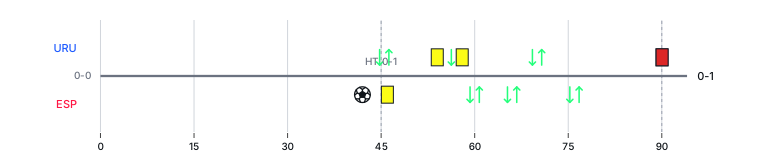
The goal in the 42nd minute was not the match. But it was the clearest moment when the structural contrast between the two sides became a number on the scoreboard. Marcos Llorente, operating high and wide on the left in the attacking half, provided the assist. Alex Baena, who spent the match stationed wide on the right, arrived inside the box and finished with his right foot. One touch, one goal, match decided.
The shot carried an expected goals value of around 0.14 — not a gift, not a tap-in, but a properly earned inside-box chance from an assisted position. Baena's average position across the match was wide on the right, which means the decisive run into the box was a departure from his broader occupation — the kind of movement wide players can make when a team is comfortable enough with the ball to allow wide men to drift into dangerous spaces. Llorente's positioning in the attacking half on the opposite flank created the crossing angle. Baena arrived where Uruguay weren't.
This sequence should not be read as a wholesale statement about Spain's attacking dominance all evening — they scored once from six shots, hit the woodwork once, and missed their one big chance. The goal was real and well-constructed; it was not proof of relentless wide-lane pressure throughout. What it was, precisely, is a single scoring sequence that did exactly what Spain's overall structure made possible: width occupied, attention split, the finisher in the right place. Uruguay couldn't offer the same clarity on their end — five shots, 0.20 xG total, one big chance missed.
Synthesis
The match had a simple logic and people will probably resist it, because simple logic in football sounds like an excuse for boring football. Spain held the ball, Uruguay couldn't find a way to take it back or move it forward usefully, and the one moment of genuine attacking craft — wide occupation converted into a box finish — was enough. 1-0. Honest scoreline.
What makes this worth examining rather than dismissing is the clarity of the gap between the two approaches. Spain's circulation wasn't decorative. It denied Uruguay the ball and, consequently, denied them the ability to supply their most dangerous player. Núñez without service is a problem for Uruguay, not a problem for their opponents. Llorente and Baena finding each other in the 42nd minute wasn't the product of some radically ambitious attacking system — it was what happens when a team controls possession long enough that the opponent's direct options grow thin and a wide run into the box goes unmarked.
Uruguay's direct route — long passes at 35% completion, crosses at 6% — wasn't unlucky. It was structurally overmatched. Spain didn't need to be spectacular. They needed to be coherent, patient, and accurate, and they were all three. The goal converted that coherence into a result. The result was fair. Football occasionally is.