
755 Passes and What They Were For
Algeria didn't just have more of the ball — they held it in a way that concentrated risk at the back and kept the ball moving until a gap appeared further up. 755 passes, 93.5% accuracy, 65% possession: those numbers describe a team recycling through their defensive line and deep pivot before committing forward, not a side playing for time.
The arithmetic behind it was mostly unglamorous. Ramy Bensebaini completed 128 of 134 passes from left back. Aïssa Mandi added 114 accurate from the right. Nabil Bentaleb, sitting in front of both, ran 113 accurate passes through the middle — 129 touches in 90 minutes, the clearest engine room of the whole thing. Those three players alone account for well over 350 passes before the ball reached the attacking half.
What that volume produced was a possession shape that made Algeria the team doing the probing and Austria the team responding. Algeria hit the woodwork and missed one big chance, so the control was not frictionless — but the direction of pressure throughout the match was consistent. The question was never whether Algeria would have more of the ball. It was whether they could turn that circulation into something specific and decisive in the final third. The answer to that was not a possession system on its own. It was a two-player connection that the circulation kept creating the conditions for.
Aouar Finds the Channel, Mahrez Finds the Net
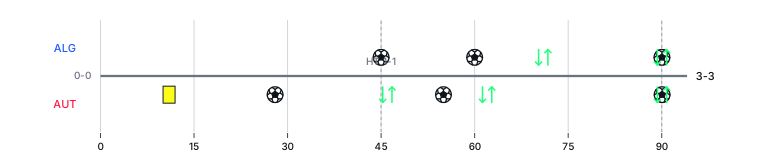
Houssem Aouar operated wide on Algeria's right. Riyad Mahrez stayed left. That positioning produced the same sequence twice in the second half: Aouar working the right side, Mahrez arriving in the finishing lane, a goal.
At 60 minutes Aouar found Mahrez for a left-footed finish from inside the box — around 0.2 on shot quality, but Mahrez made it look clean. Then in the third minute of stoppage time, the same link, higher quality: Aouar's delivery found Mahrez in almost the same left-side position, this time carrying closer to 0.45. Two goals, same connector, same finisher. Aouar ended the match with two assists and two big chances created — his expected assists of 0.4 made up a significant portion of Algeria's 1.6 total.
The lane worked because of what both players brought to the moment, not just the shape that enabled it. Aouar's job was to read when the picture was right and deliver before the window closed. His 35-from-38 pass accuracy shows he wasn't forcing it. Mahrez's job was to arrive at the right instant and convert under pressure — he was fouled twice, won five duels, and put both shots on target. The structure gave him the delivery. Recognizing when to arrive and what to do with your second touch in a tight window is the player's problem, not the scheme's. Both times it mattered, Aouar and Mahrez solved it in sequence.
Sixty Seconds, One Header, One Point
Algeria led 3-2 in the 90th minute. They had built it correctly — twice through the right-side lane — and looked like they'd earned the result. Then Austria brought on Sašа Kalajdžić at 90+5', swapping out a defensive player in the final seconds of stoppage time.
Sixty seconds later Kalajdžić headed it in. Michael Gregoritsch delivered the assist; Kalajdžić's header from a central position carried around 0.16 shot value — not marginal, a real chance converted. Gregoritsch had come on for the second half and already created one big chance and logged two key passes in 45 minutes; his expected assists of 0.22 reflected genuine presence as a supplier, not a figurehead. The goal was direct, fast, and bypassed everything Algeria had spent 90 minutes constructing.
Austria's aerial numbers across the full match tell you the physical thread was live throughout: 9 of 13 aerial duels won, a 69% success rate running counter to Algeria's superiority in almost every other dimension. Austria completed fewer than 400 passes and held just 35% possession, but they converted two big chances without missing either. The Kalajdžić introduction compressed that aerial capacity into one late moment — on the pitch it was substitution at 90+5', header at 90+6'. Whether that sequence was the explicit purpose of the change or simply the consequence of introducing a target striker with nothing left to protect, the timing itself cannot tell us. What it shows is that Austria's direct aerial route held its value long after Algeria had won almost everything else.
Synthesis
Algeria spent 90 minutes constructing the conditions for the same goal. The deep trio kept the ball moving safely and cheaply, Aouar found the right-side channel when it opened, and Mahrez arrived in the finishing lane with the timing and quality to convert. That worked twice. The second goal at 90+3' looked like a match winner built through patient, specific process — the same cue, the same connector, the same finisher, one minute before full time.
Austria had a fundamentally different relationship with the ball. With 35% possession and fewer than 400 passes, they were rarely the team in control of where the match was being played. But they won 69% of their aerial duels and converted both big chances without missing either. Gregoritsch built delivery threat from the bench across the second half. Kalajdžić came on and scored with his first meaningful touch in sixty seconds. The draw required almost no construction — one delivery, one header, one point.
The 3-3 scoreline sits awkwardly on both performances, and that tension is the honest read. Algeria earned their goals through repeated execution of a specific lane and a specific combination, the Aouar recognition and the Mahrez arrival. Austria earned their point through a single physical act that operated outside possession, key passes, and progressive circulation entirely. Two routes to goal, two very different requirements on the players — and in this match, neither idea was wrong enough to lose.