
Argentina's Circulation Compressed the Game
Eight hundred passes at 92% completion is not just a possession number — it is a description of what the game looked like for Jordan's defensive block. Argentina recycled the ball through their midfield so continuously that Jordan could never settle into a shape with any forward orientation. The ball never stopped moving long enough for the home side to step out and press with numbers, so they sat, and Argentina kept circulating.
The consequence of that circulation was territorial. Sixty passes reached Argentina's final third, and the home side's transition opportunities dried up because they rarely had the ball in positions to threaten one. When you hold 73% possession, you are also deciding how many times the opponent gets to run at your defense — and that number, for Jordan in the first half, was very small.
What the ball volume does not tell you is what Argentina were doing with their access. They created three big chances and hit the woodwork twice. That conversion gap — 2.1 xG against three goals across the full match — reflects a side that built enough entries to win comfortably even when individual finishing was inconsistent. The structure was not decorative. It was compressing the game into a shape that only Argentina could play.
Tamari Arrived and Jordan Found a Different Gear
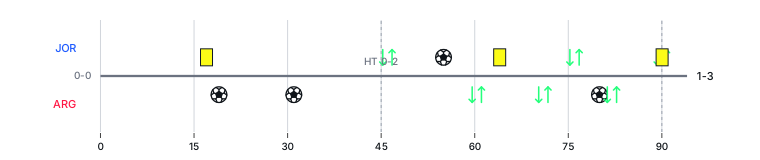
Two substitutions at the break — Mahmoud Al-Mardi on for Odeh Fakhoury, Mousa Tamari on for Ali Al Azaizeh — and Jordan looked like a different attacking problem within minutes. That is not always the case with halftime changes. Often the shift takes twenty minutes to register in the shots. Here it registered almost immediately.
Tamari scored at 55 minutes, finishing left-footed from inside the box after Ehsan Haddad's assist — a high-quality chance, sitting at 0.52 xG, that Argentina's goalkeeper could not keep out. It made the score 1-2 and, for the first time, created a live match problem: could Jordan find another goal and turn this into something?
The broader window backs up what Tamari's goal suggested. In the 46-to-60 phase, Jordan produced 0.64 xG against Argentina's 0.08. That is the clearest attacking footprint Jordan had in ninety minutes — more threatening in that fifteen-minute window than in anything they managed before or after. The timing sits right on the substitutions, though the correlation does not prove the changes caused every chance. What it does show is that the post-break Jordan was a different team to track, at least for that stretch. Argentina had to respond to a real threat, not just manage a passive block.
Dead Balls Converted Pressure into the Final Margin
Argentina's open-play circulation created territorial access. Their set pieces turned that access into goals. The two mechanisms are related but distinct — and the dead-ball route is what explains how the margin got to three.
Giovani Lo Celso's free-kick goal at 19 minutes opened the scoring with a left-foot finish from a set piece. The shot sat at 0.10 xG — low probability from that range, but converted cleanly. That is the thing about direct free kicks: the numbers undersell them when the execution is right. The corner threat was even heavier. Three corner attempts generated 0.92 xG total, including Marcos Senesi's header saved at the near post and Lautaro Martínez's left-foot effort that came back off the woodwork — a 0.56 xG chance that, on another day, is the second goal in the 28th minute.
Lionel Messi's 80th-minute free kick sealed it at 1-3. Another direct dead-ball goal, this time from wider and at lower probability, but Messi bent it in. Two free-kick goals in one match from set-piece situations is not something Jordan's defensive block had a structural answer for. Argentina earned 6 corners and 12 free kicks across ninety minutes. That volume of dead-ball entries — against a side sitting deep without the capacity to press high and foul strategically — was the extra route Argentina had that Jordan simply did not. The scoreline did not come from open-play dominance alone. It came from converting those entries with precision.
Synthesis
The match had two real threads and the final score contains both of them. Argentina's passing structure set the ceiling for what Jordan could do in open play — 73% possession is not just dominance on a spreadsheet, it is the reason Jordan's first half was almost entirely defensive. The circulation forced the home side into a deep block, and the deep block gave Argentina the dead-ball volume they needed to score twice directly from free kicks and threaten the woodwork from corners.
The halftime changes interrupted that picture. Tamari's arrival sharpened Jordan's forward movement in a way the first half had not produced, and his 55th-minute finish was a properly good goal — assisted, inside the box, 0.52 xG, converted. For fifteen minutes Argentina's clean control over the match's conditions was genuinely challenged. That window matters because it was real, not cosmetic. Jordan were briefly the better attacking side by chance quality, and 1-2 with momentum is a different game than 0-2 without it.
But Argentina had the set pieces waiting. Lo Celso's free kick had already set the table in the 19th minute, and Messi's at 80 closed it. The finishing route that bypassed Jordan's block entirely — dead balls, aerial deliveries into the box, direct strikes — was always the path Argentina returned to when the circulation alone was not converting. Jordan's brief surge asked the question. Argentina's dead-ball precision answered it before Jordan could ask again.