
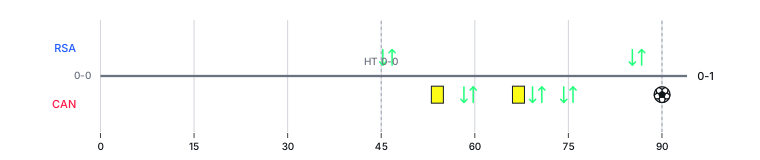
550 Passes, One Shot Inside the Box
South Africa's problem was not ball-winning — it was what they did with the ball after winning it. Five of their six shots came from outside the penalty area. Their single inside-box attempt is the number that explains the match. You cannot threaten a goalkeeper from thirty yards and expect to win.
The pass volume was real: 550 completed, nearly 85% accuracy, 58 entries into the final third. But entries that never become central combinations or box arrivals are not attacking pressure. They are recycling with a nicer postcode. South Africa generated just 0.13 expected goals across ninety minutes — a number so low it suggests the ball barely entered the areas where scoring actually happens. The final-third entries went wide, went back, went sideways. The central channel stayed closed.
This is the gap that matters. South Africa's possession was composed, not frantic. The ground-duel numbers show a team comfortable on the ball. But composure in the middle of the pitch and access to the corridor in front of goal are entirely different problems, and on this day, the second problem never got solved. Canada did not need to do anything spectacular defensively to limit the home side — the ball simply kept arriving at angles that never forced a genuine decision inside the box.
Canada's Dead-Ball Edge
Canada had 42% of the ball and lost more than half their ground duels. Neither number captures how they actually created danger. The route was simpler and more direct: win the aerial contest, get the ball into the box, and put a goalkeeper under pressure from close range.
Four corners produced five shots worth roughly 0.7 expected goals on their own — nearly half of Canada's total chance value for the match. Canada won 21 of 32 aerial duels across the game, a clear edge over South Africa, and that advantage showed in where the shots landed. Nine of their twelve attempts came from inside the box. Four were classified as big chances — the kind of opportunity the numbers suggest should produce a goal more often than not. Canada missed all four, which is the only reason this felt like a tight match for so long.
The contrast with South Africa is sharpest here. The home side was circulating possession through wide, safe corridors and eventually arriving at long-range attempts that asked nothing difficult of Canada's goalkeeper. Canada was earning dead balls, contesting deliveries in the air, and generating box entries that forced real saves. Less time on the ball, a shorter and more dangerous route to goal. The idea was simpler. The distances were right.
Ronwen Williams and the Art of Holding the Line
Five saves. Every one of them from inside the penalty area. That stat line tells you not just what Ronwen Williams did, but what Canada had built — a chance profile that kept arriving in the most dangerous part of the pitch and demanded a goalkeeper answer each time.
Williams was active as a distributor too, with 91 touches and 77 accurate passes from the back, but the defining contribution was repeated close-range shot-stopping. Canada's xG advantage was over a goal and their big-chance margin was four; the scoreline stayed at one. That gap between what the chances suggested and what the result delivered runs through Williams' afternoon. His provider rating as South Africa's standout individual was not a compliment to the team around him — it reflected how much of the defensive load landed on one pair of hands rather than being resolved by the outfield shape in front of him.
The result profile shows the scoreline supported the underlying chance quality: Canada had the xG advantage, the shot volume advantage, and the big-chance margin. Williams compressed all of that into a single-goal margin for most of the match. When the final chance eventually went in, it was the numbers catching up — not a turn in the game's structure.
Synthesis
The match had a clear internal logic. South Africa held the ball, moved it accurately, and arrived almost nowhere dangerous — one inside-box shot in ninety minutes against a side that produced nine from the same zone. Canada had less possession but a fundamentally better route to goal: corners, aerial contests, box entries, and the kind of concentrated chance value that should finish a game before stoppage time.
What the numbers keep returning to is the gap between South Africa's ball retention and their actual penetration. Fifty-eight percent possession with 0.13 expected goals is not a tactical debate — it is possession that stayed at the periphery and never found the central question that would force a defensive collapse. Canada's approach was narrower and more contingent, relying on winning specific aerial contests and converting dead balls into live danger. When it worked, it worked in the right part of the pitch.
Williams held the structure together longer than the chance profile warranted. Five saves from inside the box, a provider rating as the game's standout on his side, and a scoreline that only moved when the accumulation finally broke through. The result eventually pointed in the direction the chances had been pointing all along — but the distance between those two things, between what was created and what was scored, is the shape of a goalkeeper having an exceptional afternoon inside a match his team was losing on quality.