
The Scoreline That Took Too Long to Arrive
Brazil finished with 69% of the ball, 682 passes at over 91% accuracy, and 107 deliveries into Japan's final third. The underlying picture was even sharper: a chance-quality margin close to 1.5 units, a shot advantage of 14, four big chances created. The 2-1 result points the right direction. What it doesn't capture is how late the scoreline caught up with the process — or why a team this far ahead in territory and chance quality had to wait until stoppage time to go in front.
This isn't a story about Brazil being limited in any wholesale sense. It's about the gap between sustained control and proportionate goals, and how long Japan managed to keep that gap open. The possession was real, the ball moved cleanly, the threat was continuous. But continuous threat doesn't convert automatically when the opponent keeps enough bodies in the box to block, clear, and deflect everything short of a clean finish.
A one-goal win in the 95th minute, after hitting the woodwork and leaving two of four big chances unconverted, is a thin return on that level of territorial control. The shot and chance-quality profile makes Brazil's win entirely legitimate. But the score didn't reflect the underlying process until the last possible moment — and that gap is what this match was actually about.
Forty-Five Clearances and the Cost of Defending That Deep
Japan's box defense is where the explanation starts. They finished with 45 clearances — roughly one every two minutes — and their center-backs absorbed the bulk of that workload. Shogo Taniguchi logged 11 clearances and blocked two shots across 90 minutes. Takehiro Tomiyasu added nine clearances and another block. Between them, those two dealt with nearly half of Japan's total defensive volume, working through repetitive interventions on headers, crosses, and deliveries into the area.
What that produced in Brazil's shot profile was visible. Of 22 total attempts, eight were blocked before reaching the keeper, and the per-shot quality stayed modest across most of the match — a lot of headers off set pieces and wide deliveries rather than clean arrivals inside the box. When shots did get through, Japan's keeper handled four of them. That's not passive retreating; that's organized, high-frequency box protection that consistently shifted Brazil's best openings into lower-probability situations.
The structural cost of defending this way is real: you surrender possession almost entirely, absorb wave after wave, and rely on the center-backs to keep clearing. Japan paid that price across 90 minutes and stayed in the match. The clearances didn't stop — they just eventually ran out of time to absorb before Martinelli found the right angle in stoppage time.
The One Lane Brazil Left Open
Brazil's conceded opener was the match's sharpest illustration of what their advanced shape cost them in transition. Ten of Brazil's outfield players averaged positions in the attacking half — including defenders pushed well beyond the halfway line — and that commitment generated the territorial dominance that defined the whole contest. It also left a direct lane behind the defensive line when possession turned over.
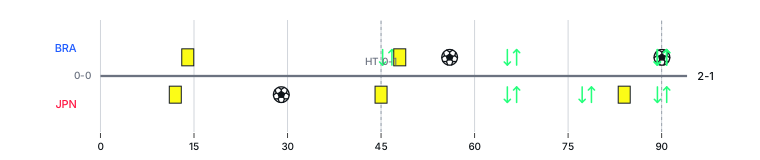
In the 29th minute, Kaishu Sano completed a fast-break finish right-footed that gave Japan a 1-0 lead. The shot carried around 0.04 in goal probability — low by any standard — but the fast-break situation gave Sano room to arrive at goal against Brazil's advanced shape. Brazil's positioning in that moment left space in behind that the recovery couldn't close. He finished, and Japan led.
The important framing here is proportion. Japan generated exactly one fast-break shot all match. Brazil had four big chances. The transition exposure was real and consequential — a 0-1 deficit after 29 minutes is a concrete problem, not a statistical footnote — but it was isolated. Brazil's advanced shape created the vulnerability once. Japan recognized it and executed. And then had to defend everything that came after.
Martinelli, Twenty-Four Minutes, One Finish
Gabriel Martinelli came on in the 66th minute for Matheus Cunha, and what followed was economical and decisive. Over 24 minutes he touched the ball 19 times, completed all 13 of his passes, and found the finish that settled the match: a right-footed goal deep in stoppage time, assisted by Bruno Guimarães, from inside the box. The shot carried genuine goal probability — around 0.21 — which made it one of Brazil's cleaner looks of the entire night.
Guimarães provided the final delivery that put Martinelli in position. The sequence was direct: the ball arrived, Martinelli read the space, the finish came right-footed and on target. For a match where Brazil had generated chance after chance without converting their territorial pressure into a lead, the execution in that moment was exactly the difference.
The substitution window shows the shape of what followed. The first five minutes after Martinelli entered produced nothing directly; the next 15 brought two shots, and eventually the winner. Timing shows sequence, not cause — but Martinelli entered, operated without waste, and converted the one shot that decided the match. When the process finally matched the scoreline, it was him who closed it.
Synthesis
Three things were true simultaneously in this match, and none of them cancels the others. Brazil controlled the ball and the territory almost from kickoff — 69% possession, 682 passes, 107 deliveries into Japan's final third, a shot advantage of 14. Japan protected their box with a volume and collective discipline that kept the score from reflecting that control at anything like the rate the underlying chance quality suggested it should. And in the 29th minute, the very shape that generated Brazil's pressure left a lane open, Sano found it, and a low-probability fast break became the goal that forced Brazil to chase for an hour.
That sequence — advanced spacing creating a transition gap, one fast-break finish, 45 clearances absorbing the response — is what the match was actually built around. The 2-1 scoreline looks clean. The mechanism underneath it was compressed, contested, and eventually resolved by a substitute finding the right angle in stoppage time.
When Martinelli put the ball in the net in the 95th minute, the territorial and chance-creation work had been pointing toward a Brazil win since the opening whistle. But recognition still had to happen in real time: the delivery arrived, the angle was there, and he finished it. The structure built the conditions. The player had to see them — and in the last possible moment, he did.