
Germany's Wide Control Map
Kimmich was the engine of Germany's shape, and the numbers show what that looked like in practice: 178 touches, 141 passes, 16 crosses, sitting high and centrally but constantly feeding the right flank. The team's crossing volume across the full 120 minutes reached 56. That is not incidental — it reflects a team whose possession kept arriving at the wide channels and staying there, with service into the box as the primary route to goal.
Wirtz worked the opposite side in a complementary role, and Germany's average positions confirm how far forward the whole structure pushed. Fourteen of seventeen players averaged in the attacking half. The midfielders averaged even deeper into the final third, with forwards highest of all. What this gave Germany was territorial dominance and the ball — 75% of it, with 127 final-third passes backing up what the spatial picture shows. The structure kept Paraguay pinned back, kept the ball in Germany's feet, and kept the pressure consistent.
What the wide structure did not consistently deliver was central penetration. Half of Germany's shots came from outside the box, and the cross accuracy from Kimmich specifically — 1 from 16 — reflects how well Paraguay coped with the delivery end of that pattern. The possession was real. The control was real. The conversion gap between what Germany generated and what they scored is where this article lives.
Paraguay's Answer: Absorb, Clear, Repeat
Paraguay's defensive response showed up in the numbers before it showed up anywhere else. Fifty-four clearances. Thirty-three tackles. A pass accuracy of 63% — the natural consequence of a team that spent most of the match under pressure rather than building with it. Ten of their sixteen outfield players averaged centrally, sitting deep and keeping the block tight through the middle.
The individual workloads tell the same story at the player level. José Canale, operating deep on the left side of the defensive line, finished with 15 clearances, five tackles won from five, and two blocked shots across 120 minutes. His average position was pinned well inside Paraguay's own half. Gustavo Gómez anchored even deeper. Damián Bobadilla contributed eight clearances and three interceptions from midfield. The block was not passive — it required sustained physical output from players defending close to their own goal for two full hours, absorbing wave after wave of German wide delivery.
What this structure cost Paraguay is visible in their attacking numbers: seven shots, an expected goals total under half a goal, 25% of the ball. They were not trying to match Germany's output phase by phase. They were concentrating bodies, winning headers, clearing crosses, and making the pitch feel smaller for the team trying to break them down. For 90 minutes and into extra time, that was enough.
Wirtz: The One Who Kept the Pressure Alive
Four key passes, one big chance created, 10 crosses, 80 pass attempts — and the assist on Havertz's 54th-minute equalizer. Wirtz carried more of Germany's creative burden than any other player on the pitch, and the expected assists figure makes that visible: 0.67 across the match, meaning the passes he threaded into dangerous positions should have produced considerably more than the single goal Germany scored.
The assist itself is the clearest illustration of what he offered. Wirtz found Havertz at the right moment, the right angle, and Havertz finished. That sequence — the pass that creates the decision before the shot — is what Wirtz kept generating. Four key passes that did not all become goals is not a distribution failure by the creator; it is a conversion story the rest of the attack did not resolve.
His 110 minutes also show the physical cost of being Germany's primary thread into the final third. Eight duels won, six lost, five dribble attempts, two tackles contributed defensively. That is not a player floating in space waiting for the ball — it is a player working both directions inside a structure that needed him to. Germany's best open-play moment ran through Wirtz. The problem was that it only converted once.
Gill's Wall: What Six Saves Actually Meant
Six saves from Orlando Gill, four of them inside the box. Inside-box saves are the ones that flip scorelines — those are attempts that, at normal conversion rates, find the net. Gill stopped four of them. He played all 120 minutes, faced a German team that generated 11 shots inside the box, and came out of it as the official man of the match.
The combination of the defensive block in front of him and his own shot-stopping is what makes Paraguay's performance coherent. The block kept many of Germany's attempts to the outside and to crosses, but shots still got through — six times, Gill was the last line. Remove either piece and the 1-1 scoreline through 120 minutes becomes very hard to sustain. Paraguay's defenders cleared and tackled. Gill handled what broke through.
What this means for the process-result gap is simple: Germany's xG margin across the match was over a goal in their favor, and their shot margin was 14. The underlying numbers say the better open-play team should have scored more. Gill is a large part of the reason they did not. That is not a criticism of Germany's creation — it is recognition that quality in goal can absorb quality in attack, and Gill's performance did exactly that.
Woltemade, Goretzka, and the Extra-Time Spike
Germany's most concentrated attacking spell came in the first half of extra time, when five shots worth 0.84 in expected goals arrived in fifteen minutes. Paraguay produced nothing in that window — zero shots, zero xG. The clearest late pressure Germany applied across the whole match came after Woltemade had entered at minute 88 and Goretzka had been on since halftime.
Woltemade's individual profile in his 32 minutes illustrates what changed at the attacking end: two aerial duels won, three duels won overall, 0.28 in expected goals from his direct involvement. He offered a different kind of target than the player he replaced — taller, more physical in the box, winning ball in the air. Goretzka added box-entry threat of his own, finishing with 0.25 in expected goals across 75 minutes. The two substitutes shifted Germany's attacking profile toward something more direct.
Timing coincidence is not the same as causality — the phase summary cannot prove the changes caused the surge. What it does show is that Germany's five-shot, 0.84 xG window in the 91st to 105th minute was their best concentrated attacking period of the match, and it arrived while those two substitutes were on the pitch. It still did not produce a goal. That is the shape of Germany's night: the process kept escalating, the volume kept rising, and the scoreline stayed at 1-1.
From 1-1 to Penalties
When 120 minutes ended at 1-1, the match had produced a goal margin of zero and an xG margin of over a goal in Germany's favor. The shot margin was 14. By the measures that describe open-play dominance, the gap between the two teams was not close. And none of that mattered.
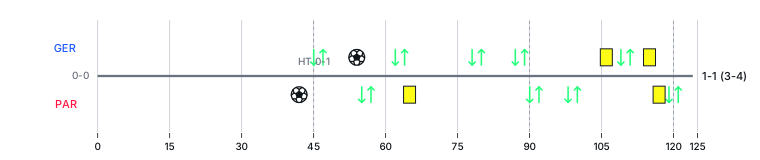
A penalty shootout runs on its own logic. Paraguay converted four of their attempts. Germany converted three. The final score in the shootout was 4-3 to Paraguay, who advance. That outcome does not rewrite what happened in open play — it just resolves the tie that the 1-1 created. Paraguay kept the game level through compactness and Gill's saves long enough to reach a format where 120 minutes of shot volume carries no weight. They scored first in the first half, Germany equalized through Havertz in the 54th minute, and neither side scored again. Two goals across two hours, then a shootout.
The process-result gap here is not subtle. Germany generated the chances, held the ball, pushed the late pressure, brought on the substitutes, and produced the extra-time spike. Paraguay survived it all — and when the format changed, they were ready for it.
Synthesis
The sequence that decided this match is not hard to reconstruct. Germany built a wide, cross-heavy possession structure with Kimmich and Wirtz as its connectors. It produced territory, shot volume, and the Havertz equalizer at 54 minutes. It did not produce a second goal.
Paraguay's response was to pack bodies centrally, clear crosses, and make Germany's wide delivery feel repetitive rather than threatening. Canale's 15 clearances and Bobadilla's defensive output represent the human cost of defending for two hours against a team with 75% of the ball. Then Gill handled what breached the block: six saves, four inside the box, man of the match by a comfortable distance.
Wirtz was the one German player who consistently threatened to break that combination. His 0.67 expected assists over 110 minutes reflects passes that should have produced more than they did. Germany's late bench changes — Goretzka from halftime, Woltemade at 88 — coincided with their best attacking window, five shots worth nearly a goal in the first half of extra time. Still 1-1.
The shootout resolved the tie, not the football argument. Paraguay needed the block to hold, the keeper to save, and the format to change — and all three came through. Germany needed one more conversion from a process that kept generating the right cues and finding the distances just short of decisive. That gap between the cue and the execution is where this result was settled.