
The Defensive Burden Norway Accepted
Norway came to Abidjan and immediately took on a physical contract: absorb pressure inside the box, win the aerial battles, and keep Cote d'Ivoire from finding central routes to goal. Over 90 minutes, they made 37 clearances and won nearly 60 percent of all aerial duels. That is not a comfortable performance — it is a performance built on tolerance of sustained defensive output.
Kristoffer Ajer was the structural anchor of that resistance. He completed 13 clearances himself, went 4-for-4 in aerial duels, and won all seven individual battles he contested. Torbjørn Heggem contributed five more clearances in support. What those numbers describe is a back line that kept returning to the same problem — crossed balls and headers — and kept solving it. The accumulation across the full 90 minutes made Norway's box difficult to breach through the middle.
The mechanism here is constraint-driven. Cote d'Ivoire's ground duel win rate reached over 60 percent, so the contest in open field mostly favored the home side. But inside Norway's defensive shape, that advantage disappeared. Norway conceded the territory between boxes while protecting what mattered most. Whether that was a deliberate plan or simply a performance shape that emerged from the match is something the numbers alone cannot confirm — but the effect on Cote d'Ivoire's attacking options was real.
Twenty-Nine Crosses, Seven Completions
Cote d'Ivoire's attacking shape in this match looked like a natural response to what Norway offered: a compact, aerial-dominant defensive block that closed off central lanes. So the home side went wide — repeatedly, and at significant volume. Twenty-nine crosses in a single match is a commitment. Completing only seven of them is what that commitment cost.
The crossing load was distributed across multiple players. Ghislain Konan attempted five crosses from the left and completed one. Guéla Doué sent five more across and found a teammate twice. Nicolas Pépe delivered seven, connecting on two. None of those numbers describe a player cutting through the backline — they describe a team running the same delivery route and meeting the same aerial resistance at the other end. Norway's 59 percent aerial duel win rate was the wall the crosses kept hitting.
What this profile reveals is not necessarily a tactical failure by design. Cote d'Ivoire finished the match with 14 shots and an xG around 1.4, which reflects real attacking intent. But the route to those chances ran predominantly through the flanks, not through the center. With Norway's defenders winning headers and clearing deliveries, the home side's final-third entries produced volume without the precision needed to convert it. The gap between 29 crosses attempted and 7 completed is the clearest single number in this match — it is a measure of how thoroughly Norway's box compactness redirected Cote d'Ivoire's attack.
The Bench Tilted the State
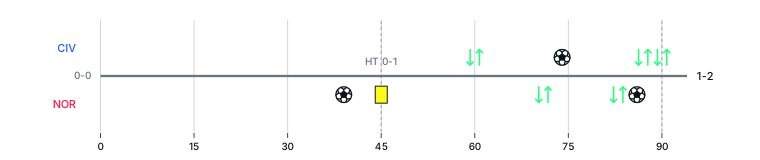
At the hour mark, with Cote d'Ivoire trailing and Norway's defensive shape intact, the home bench moved. Amad Diallo came on for Christ Inao Oulaï and Elye Wahi replaced Ange-Yoan Bonny — a double change that injected different attacking movement into a structure that had spent sixty minutes searching for a way through.
What followed was a measurable shift. In the fifteen minutes after those substitutions, Cote d'Ivoire generated three shots and, more importantly, found the equalizer. Diallo scored in the 74th minute — left foot, from inside the box, assisted by Pépe — to make it 1-1. The shot carried an xG around 0.2, a modest-quality chance that became a goal. Diallo was the one the double change brought on, which makes the sequence worth noting even without claiming the changes caused the goal. Timing and causation are different things, and the available record cannot close that gap.
What the record does show is that the home side's attacking output climbed after 60 minutes, that the substitutes were directly involved in the equalizing sequence, and that Norway — who had been absorbing pressure effectively — suddenly faced a different problem: they needed to win a match that was now level with under twenty minutes remaining. That shift in score state changed the available options for both sides, and it created the conditions that the final ten minutes would resolve.
Berg Found the Room That Mattered
Patrick Berg finished this match with a stat line that tells a quiet story: 30 accurate passes from 33 attempts, two big chances created, an xA of 0.83, and one assist — the one that decided the game. For a midfielder who lost possession only five times across ninety minutes in a match Cote d'Ivoire was pressing to control, that is a profile defined by efficiency under pressure rather than volume.
The winning sequence at 86 minutes worked because Berg found space and Haaland was waiting in the center. The delivery reached Haaland inside the box, and the shot that followed carried an xG of 0.8 — essentially a near-certain goal from that position, converted left-footed to make it 1-2. What the mechanism required was a pass that bypassed Cote d'Ivoire's defense at the moment they were most stretched: chasing an equalizer, committing men forward, leaving Haaland with the kind of central opportunity that Norway had been unable to engineer through open play for most of the match.
Berg's role across the full game was less visible than that final moment suggests. Two big chances created over ninety minutes is a meaningful creative output, but Norway's attacking profile was not built around sustained midfield combinations — it was built around defensive resistance and quick transition. The 86th minute worked because Berg recognized what Cote d'Ivoire's pushed-up shape had left behind, and delivered the pass that made the space count. That recognition is what the assist number cannot fully represent, and it is what separated this match from a draw.
Synthesis
The shape of this match is easier to read backward than forward. Norway spent the evening accepting a defensive burden — clearing crosses, winning headers, keeping Cote d'Ivoire's wide deliveries away from the goal — while generating a 2.0 xG on just nine shots by concentrating their threat in the box. Cote d'Ivoire did the opposite: more shots, more crosses, more ground possession, but an xG of only 1.4 and a crossing accuracy that barely reached one-in-four.
Those two profiles create the contrast the match turned on. Norway's resistance was not passive — it was a structural cost they accepted to stay compact and protect central entry. Cote d'Ivoire's wide delivery volume was the answer to that compactness, but it was an answer Norway's aerial duels kept refusing. When the double substitution at 60 minutes temporarily disrupted that dynamic and Diallo's goal made it level, the match opened up — and opening up is not always a problem for a team with Haaland waiting in central space.
Berg's pass at 86 minutes was not random good fortune. It was the kind of thing that becomes available when the defending team is pushing for a result and leaves width behind them. Norway's defensive shape had compressed Cote d'Ivoire into a crossing game for most of the match; the equalizer reversed that pressure briefly; and then Berg found the gap that the reversal had created. The defensive burden and the winning goal are the same story told from opposite ends — a match that Norway structured around absorption and finished with precision.