
Sweden's Attack Never Found a Real Base
Sweden finished with 8 shots and 0.64 expected goals—and not one big chance across ninety minutes. That's the problem before anything else: they found the box often enough (seven of eight attempts came from inside it), but arrival didn't translate into danger. Their per-shot average sat at 0.08, which is the number of a team reaching positions rather than threatening from them.
The phase-by-phase distribution reinforces it. Sweden's best xG clusters came in the 16-30 window and then again late, when the scoreline was already settled at 3-0. Neither window produced anything France's goalkeeper couldn't manage. Three shots on target all match. No fast breaks. One corner attempt. The attacking moves were present in shape but absent in consequence.
What the totals cannot pin down is exactly why Sweden's output stayed so thin—whether France's compactness in midfield constrained their progression routes, or whether Sweden simply couldn't find the right moment in the final third. What the numbers confirm is that Sweden never created the kind of platform that makes a deficit negotiable. They got into the box, they took their shots, and they came up empty in value every time. That's not a conversion problem. That's a chance-quality problem, and it ran the full length of the match.
France's Edge Was Broader Than the Scoreline Suggests
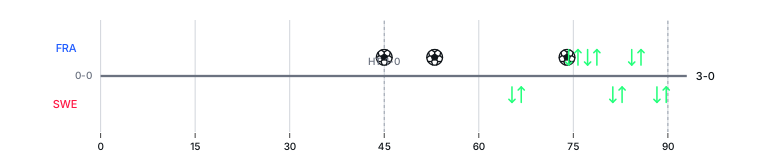
France's 25 shots and 3.17 expected goals didn't come from a single productive spell. The output accumulated across multiple phases and kept building into the second half—the 61-75 window alone generated over 1.1 xG, the 31-45 window added 0.76, and a transition layer operated as a separate source of value on top of the buildup threat.
Sixteen of the 25 attempts came from inside the penalty area. France created six big chances and converted two of them, hit the woodwork twice, and still scored three. A more clinical finish on those big chances and the margin grows past three. The per-shot average of 0.13 already outpaces Sweden's number, but what it doesn't capture is the variety: corner shots, assisted chances, fast-break finishes, and regular-play attempts all contributed. No single route was carrying the whole weight.
The 17-shot gap between the two sides, combined with an xG difference of roughly 2.5, makes the result a fair reflection of the match's attacking output. This isn't a case where the process told a different story and the scoreline diverged—France's shot profile and Sweden's shot profile were pointing in the same direction from the opening exchanges. The question for the next sections is which mechanisms inside that France total did the most work.
Olise: The Passing Layer That Kept France Connected
Ninety-four touches in 85 minutes means Olise was finding the ball in rhythm almost constantly. What matters is what he did with that volume: 69 passes attempted, 63 completed, eight crosses into the box, two assists, and two big chances created. His expected assists figure of 0.77 is the tell—that's not a player recycling possession, that's a player finding deliveries into positions that matter.
Olise held centrally in the attacking half, with enough right-side movement to collect wide deliveries and enough central presence to act as the relay between midfield and the striker. From that zone, he fed the sequences that produced goals—twice. Two big chances created from one player across a single match is a meaningful output, not just a volume stat.
The function here matters more than the position. Olise was the player who decided when the ball moved forward and what the forward picture looked like when it did. Sweden's defensive block had to account for him every time possession recycled in the center, which is a constraint on their shape before any run is made or any cross is attempted. When Mbappé found space centrally, Olise was typically the player who read it first and delivered into it. That's the link the attack kept returning to.
Mbappé as Final Layer: Finish and Creation in the Same Role
Two goals. Four shots on target. Four key passes. Mbappé's xG across 85 minutes was 0.63, which means the goals were harder than they might look on the scoresheet—not routine finishes from gift positions, but attempts that required execution. He also created one big chance while missing one himself. The four key passes are the detail that separates this from a pure striker performance: he was pulling into combination moments and then arriving in the right place when the chance came back around.
His average position was in the central attacking lane, deep in France's attacking third. That's not a wide outlet role—he was occupying the space directly in front of goal, which forced Sweden's back line to account for him whenever France moved the ball forward. With Olise operating just behind and to the right, Mbappé had a reliable creator feeding him and an equally reliable threat pulling defensive attention away from him.
All six of his long-ball attempts went accurate, which shows he wasn't passive during spells out of possession—he was working full-pitch. Two goals, four shots on target, four key passes, and a central position that demanded constant defensive attention: the scoresheet captures the outcome, but the process behind it was more varied than a simple finisher read.
The Fast-Break Lane That Kept Reopening
France's five fast-break attempts produced 1.57 xG—nearly half their total xG from a situation type that accounted for only a fifth of their overall shots. The route was efficient every time it opened.
Barcola's 53rd-minute goal is the clearest record in the data: a right-foot finish from inside the box, carrying 0.56 xG. The 46-60 phase as a whole had France scoring once from two shots worth 0.58 xG, while Sweden could answer with just 0.04 xG in the same window. The fast-break lane was operating at its sharpest value right when Sweden needed possession back and had to push their lines forward. France recognized the space opening and got in behind.
The same route returned at 82 minutes—another Barcola fast break, a 0.33 xG left-foot attempt that Zetterström got down to stop. The threat didn't close as the match settled. Sweden's need to chase a 3-0 deficit kept the transition window available, and France kept finding it. Five attempts, genuine xG value on each one, one goal and multiple near-misses that maintained pressure through the final twenty minutes. The fast-break lane wasn't a one-off exploit. It was a recurring structure that Sweden's forced forward shape kept feeding.
Zetterström's Workload: What Nine Saves Actually Means
Jacob Widell Zetterström made nine saves across ninety minutes, four from inside the box. France's goalkeeper needed three. That asymmetry is the most direct summary of how lopsided the shot-stopping burden was—not a stylistic observation, a workload fact.
The result profile shows an xG margin of 2.53 in France's favor and a shot margin of seventeen. France created six big chances and converted two. They hit the woodwork twice. Against that volume and value, Zetterström's nine saves delayed and reduced the margin—but they couldn't contain it. The 3-0 scoreline actually sits below what France's chance profile suggested, which means Zetterström's intervention was real and measurable, even if the result stayed comprehensive.
This isn't a story about individual heroism softening a deserved defeat. It's a story about what happens when a side facing 3.17 xG over ninety minutes has one player absorbing nearly all of the defensive responsibility at the final line. Save totals show workload, not the quality of every intervention or the defensive decisions that preceded each attempt. What the numbers do confirm is that without those nine saves, France's margin grows past three. Zetterström kept it there—which says something about his performance and considerably more about the attacking output Sweden were trying to contain.
Synthesis
Two threads, and they never crossed in Sweden's favor. Their attack generated 8 shots and 0.64 xG across ninety minutes—no big chances, no fast breaks, nothing that forced a real decision at the back. That's not bad luck and it's not conversion failure. Sweden never built a platform where converting became a realistic question.
France's 3.17 xG arrived in layers. Olise carrying the passing structure from his central hub, deciding when the ball moved forward and what picture Mbappé got when it did. Mbappé arriving in those positions, scoring twice, and contributing four key passes that kept the forward options alive even when he wasn't the one finishing. And then the transition route—five fast-break attempts, 1.57 xG, a recurring lane that Barcola exploited directly at 53 minutes and nearly again at 82. Three different mechanisms producing value, none of them dependent on the others firing perfectly.
Zetterström's nine saves made the final line look less wide than the underlying numbers suggested. An xG margin of 2.53 landed as a three-goal result. But that's not the match telling a different story—that's one goalkeeper doing exceptional work at the end of a one-sided process. The 3-0 is a fair reading of what France manufactured and what Sweden could not. The cue was always there; Sweden's recognition never came.