
Morocco Set the Terms — and Left Them Unresolved
There is a particular kind of territorial control that looks authoritative on the sheet and unfinished on the pitch. Morocco's game against the Netherlands was that kind. They completed 878 passes to the Netherlands' 373. They held 70% of the ball. They reached the Dutch final third 102 times. The Netherlands, with 60 final-third passes and 30% possession, spent the match largely in receipt of pressure rather than generating it.
What the ball-share cannot explain is why none of that volume forced a clean decision before the 71st minute. Morocco's passing was precise — 91% accuracy — and their buildup moved with enough confidence to pin the Dutch back across long stretches. But territory and resolution are different currencies, and Morocco kept spending the first without cashing the second. The Netherlands made five saves. Morocco required only one.
All of this matters as baseline, not verdict. It frames what came later: two bench moves, one Dutch and one Moroccan, that dragged the scoreline away from what the field picture had been patiently assembling. Morocco set the terms of this match. They simply could not enforce them cleanly enough to make the late drama irrelevant.
One Minute After Weghorst, Gakpo Scored
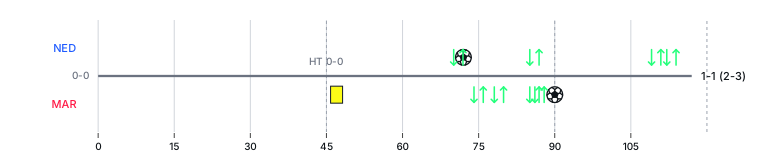
The Netherlands produced 0.23 xG across the entire match. Their single big chance arrived one minute after the 71st-minute double substitution — Wout Weghorst on for Brian Brobbey, Teun Koopmeiners in for Nathan Aké. At 72 minutes, Crysencio Summerville assisted and Cody Gakpo scored. First Dutch regulation goal. First Dutch regulation big chance. One minute apart from the bench change.
The temptation is to call this proof of tactical genius. The honest version is tighter: timing is timing. What Weghorst brought was a physically distinct problem — a forward who wins aerial duels, creates congestion, and demands a different kind of spatial attention than Brobbey. He won seven total duels, four of them aerial, across 49 minutes. Whether his presence directly freed Gakpo in the buildup to that goal, or simply changed the geometry by appearing in the box, is not something the record resolves. The sequence is: Weghorst on at 71, Gakpo scores at 72, Summerville with the assist. The evidence supports the timing. It does not prove the design.
What it produced was the Netherlands' only regulation goal — a right-footed finish carrying modest individual probability — from a side that had offered almost nothing before the bench moved. Efficient in the way a pickpocket is efficient: fast, opportunistic, and done before the room adjusted.
Talbi On at 87, Diop Equalizes at 90+1
Morocco's answer arrived through its own compression. Chemsdine Talbi entered the right flank in the 87th minute — trailing by one, four minutes left in regulation, penalties or exit waiting. Four minutes after that, Issa Diop headed in the equalizer. Talbi provided the assist.
Diop's header carried around 0.18 xG: a meaningful probability for a headed chance inside the area, and Morocco's goalkeeper had been called upon exactly once all match. The goal was assisted, the finish was clean, the timing was extreme. Talbi's average position across his brief appearance sat wide on the right, but his direct involvement was immediate — an assist inside four minutes of introduction, produced in the window when Morocco most needed it.
As with the Dutch change nineteen minutes earlier, it would be sloppy to say Talbi alone caused the goal. The substitution window evidence supports correlation, not causation; the full buildup chain and defensive assignments are not in the record. What is in the record: Talbi on at 87, assist and goal by 90+1, Morocco level. Whether that reads as fine management or fortunate timing probably depends on which bench you were sitting on.
Five Big Chances, One Goal — The Gap That Kept It Open
Strip away both substitution windows and what remains is a Morocco team that built 1.4 xG across 11 shots, created five big chances, missed four of them, and hit the woodwork once. The Netherlands goalkeeper made five saves. Morocco needed only one from theirs.
Five big chances missed is not a rounding error. It is the football equivalent of writing a strong brief and losing the case anyway. Morocco had enough volume to win this game well before Diop needed to rescue them in stoppage time. But generating big chances and converting them are different disciplines, and Morocco's shot profile shows a team that reached dangerous positions with regularity and then — repeatedly — didn't. Seven of their eleven attempts came from inside the box. The xG concentration shifted dramatically late: more than 0.75 xG came in extra time alone, much of it from score-state pressure that Morocco had forced upon themselves by failing to finish earlier.
The result the process picture invites is a comfortable Morocco win. The result the scoreline produced is a 1-1 draw settled by penalties. That gap — between what the territory promised and what the conversion delivered — is why two bench moves in the final twenty minutes of regulation could matter so much. When you leave five big chances unconverted, you hand the match to the precise moments you could least afford to lose.
Synthesis
Morocco were the better team by almost every measure that is supposed to matter before the penalty spot. They had the ball, the passes, the final-third access, and the chance volume. The Netherlands had 0.23 xG and a goalkeeper who made five saves. By the ordinary logic of football, this should not have been close.
And yet. Morocco missed four big chances and watched a side offering almost nothing score from a modestly probable right-footed finish, one minute after a bench change no one can prove was designed for exactly that outcome. Then Morocco needed their own late substitute — on for four minutes — to feed an equalizing header in stoppage time just to reach penalties. Both bench moves produced goals within a minute or two of the change. Neither can be cleanly assigned to brilliant management rather than capable players arriving in the right compressed moment.
What the full picture reveals is not that Morocco were unlucky or that the Netherlands were clever. It is that Morocco's territorial control was real and their finishing was not — and when you leave five big chances on the pitch, you create exactly the kind of match where a single sharp sequence from the other bench can change everything. The Netherlands survived by spending almost nothing and cashing one chance at the right moment. Morocco built a compelling argument across ninety minutes and then had to send a center-back forward in stoppage time to keep it alive. Effective possession without conversion is not dominance. It is a prolonged invitation.