
The Scoreline Is Doing a Lot of Work Here
Belgium won 3-2. They also generated 1.8 in expected goals against Senegal's 3.4. The gap between those two facts is the whole match — and calling Belgium's victory a comeback story without acknowledging the chance balance is the kind of convenient forgetting that makes football discourse so reliably bad.
Senegal struck the woodwork twice and converted just two of their three big chances. Belgium missed none of theirs. The conversion rates were close enough — Belgium at roughly 16 percent, Senegal at 11 — but the volume of quality Senegal generated was not remotely reflected in the scoreline. A team that accumulates that kind of chance value in 120 minutes and loses deserves more than a footnote about resilience in the winner's post-match coverage.
None of this proves Belgium were outplayed in every corner of every phase. They had marginally more possession, a slightly better pass accuracy, and they found the net when it counted. But the negative xG margin of 1.6 goals is not noise. It is the match's actual skeleton, and Belgium's 3-2 win sits on top of it like a confident man who borrowed someone else's suit. The result is theirs. The process was not.
Down 0-2, Belgium Found the Only Version of the Game That Could Save Them
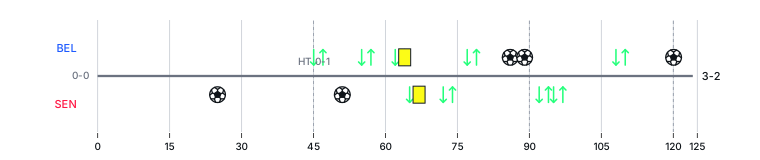
Trailing 2-0, Belgium's options were not subtle. They needed goals, which meant volume, which meant sustained pressure on a Senegal side that — once the lead was comfortable — stopped looking to extend it. Between minutes 52 and 86, Belgium produced 10 shots. Senegal produced zero. That is not a tactical masterclass; it is what happens when one team is desperate and the other stops moving.
The final 15 minutes of regulation sharpened that picture further. Belgium put seven shots on Senegal's goal worth roughly half an expected goal; Senegal managed two, worth almost nothing. The scoreline during this window moved from 0-2 to 1-2, which is the mathematical minimum for the comeback to remain possible. Whether Senegal chose to absorb pressure or were simply pushed back by Belgium's urgency, the shot record is stark: for a stretch of more than half an hour, one team was playing football and the other was surviving.
The important qualifier is that Senegal did survive — until they did not. A deep defensive posture reduces transition outlets, and sustained pressure eventually finds cracks in even well-organized lines. Belgium's late shot volume was the condition for the result; it was not the result itself. That required something more specific than effort.
Meunier Gave the Right Side Something to Say
Thomas Meunier entered at the 78th minute in place of Maxim De Cuyper, and Belgium's right-side delivery changed immediately. Within five minutes he was involved in two shots worth just over 0.10 xG; across the full 54-minute spell he registered an assist, two accurate crosses from three attempts, two key passes, and one big chance created. These are not the numbers of a player who merely kept the position warm.
What Meunier provided was a specific kind of width — active, delivery-focused, prepared to get the ball into dangerous areas quickly. In the 15-minute window after his introduction, Belgium generated six shots worth 0.45 expected goals and scored twice. The timing is correlation, not causation; but a cross that directly leads to a goal is not easily dismissed as coincidence either. The right flank was, for those minutes, the address where Belgium's comeback lived.
The limitation worth keeping is that the evidence tells us what Meunier produced, not what changed structurally or why the bench decision was made. A player stat line and a substitution window are facts about output. They do not reconstruct tactical intent. What they do show is that Belgium's right side became an attacking instrument in the closing stages, and that Meunier was the one operating it.
Tielemans Carried the Finishing Burden for 132 Minutes
Youri Tielemans scored twice and was on the pitch for every minute of a 120-minute contest. That sentence understates what it costs. He played through a deficit, through extra time, and ended the match by converting a penalty in the fifth minute of stoppage time in the second period of extra time — a shot worth nearly 0.79 xG that found the net and left Belgium with a result that, on the numbers, they had no business claiming.
The penalty at 120+5' was the kind of moment that gets mythologized in inverse proportion to how difficult it actually is. A penalty that high in xG is a penalty that most professionals convert; the difficulty was everything before it — the 132 minutes of staying relevant, accumulating, and arriving at the moment with the nerve to finish. Tielemans' full stat line showed two shots on target from two goals, 65 passes with 54 accurate, seven duels won. He was present in the match's labor as well as its climax.
What the record cannot tell us is whether Tielemans invented the late structure or simply filled a role that the bench changes and the pressure window had already created for him. Probably both. The finishing still had to happen, and he is the one who did it. Belgium won 3-2 because of a player who, across 132 minutes, refused to let the chance balance be the final word.
Synthesis
The honest reading of this match is uncomfortable for Belgium supporters and probably not satisfying enough for Senegal's. Belgium won despite generating 1.8 expected goals to Senegal's 3.4. They won because they converted every big chance and Senegal left one untaken. They won because Senegal, once ahead by two, stopped threatening — conceding 10 unanswered shots between the 52nd and 86th minute — and that retreat gave Belgium the pressure window they needed. They won because Meunier's wide delivery immediately after coming on changed what the right side could produce. And they won because Tielemans, across a full extra-time match, scored the two goals that mattered most.
None of those four facts cancels the others. The result and the process are both real, and the gap between them is what makes this match worth examining rather than simply celebrating. A team that wins this way has not proven it is good; it has proven it is dangerous. There is a difference. Belgium's conversion of all three big chances is a fact. Senegal's 3.4 accumulated expected goals is also a fact. Football sometimes allows both things to coexist in the same 120 minutes, and the result goes to the side that finishes — not the side that deserved it most by the measure of chance quality alone.
Senegal played better football than the scoreline records. Belgium played well enough at the moments the scoreline required. Those two sentences are not in contradiction. They are the match.