
Sixty-Eight Minutes Behind
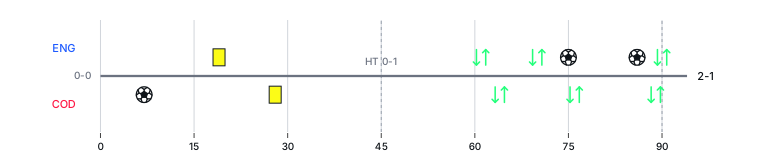
Brian Cipenga's goal in the 7th minute didn't just put England behind — it set the structural terms for everything that followed. A team trailing that early doesn't simply need to score; it has to press into a situation where the opponent can now make rational, conservative choices. DR Congo had a reference point to defend. England had to dismantle it.
That chasing state ran from minute 8 through minute 74. Sixty-eight minutes is a long time to operate with the scoreline working against you. During that stretch England generated 11 shots and accumulated close to 1.8 in chance quality — genuine attacking output for a side pressing from behind, but not enough to break through until the game's final quarter. The score sat at 0-1 through almost the entire second half before Kane's equalizer finally arrived.
The early goal didn't manufacture England's difficulty from nothing. It revealed the cost of conceding first to a side willing to absorb pressure and defend its advantage. That cost compounds over time: each failed chance reinforces the defensive structure it was meant to disrupt. England eventually cleared it, but the path there required more than an hour of sustained, unrewarded effort before the match's logic finally shifted.
DR Congo Made Every Advance Expensive
DR Congo finished with 36 clearances, 20 tackles, and 5 saves — and attempted only 7 shots of their own. That asymmetry describes a side that understood its position and worked hard within it. The statistics cannot confirm a deliberate low-block design, but the workload is not in doubt: DR Congo spent the majority of this match doing defensive work at high volume.
Goalkeeper Lionel Mpasi Nzau made five saves, four of them from inside the box — the kind that require late reactions to close-range attempts rather than comfortable catches at the edge of the area. At fullback, Aaron Wan-Bissaka contributed 7 clearances and 3 tackles, a defensive output that resembled a second center-back more than a wide player with license to join attacks. These weren't peripheral contributions. They were the mechanism by which a narrow lead held for nearly 70 minutes against a side with England's attacking resources.
England's chance quality during the trailing period was real — concentrated inside the box, with enough value to expect at least one conversion. DR Congo kept finding bodies in front of the ball anyway. The result was a match that stayed at 0-1 long past the point where it felt likely to, and that resistance made the eventual comeback as hard-won as it actually was.
The 61st Minute and What Changed After It
With the score still 0-1 at the hour mark, England made two simultaneous substitutions: Bukayo Saka on for Noni Madueke, Anthony Gordon on for Marcus Rashford. The match's final shape was written in what followed.
Gordon's numbers from 29 minutes on the pitch: two assists, two key passes, one big chance created, three crosses into the box. His expected-assists figure for that window was 0.21 — a delivery record that covered a narrow time frame but produced decisive output inside it. The equalizer at 75 minutes came from a Gordon cross met by Kane's header. The winner at 86 minutes came through a second Gordon assist. Two goals, both of them routed directly through a player who had been on the pitch for less than half an hour.
The record shows timing and production, not a preplanned tactical blueprint. What it does show clearly is that England's final-third delivery changed shape after Gordon entered — and the goals followed that change. That's the supported reading: a substitution window that coincided with a shift in output, not a coaching masterstroke we can prove was designed for this exact opponent at this exact moment. The chain from substitution to assists to scoreline reversal is real. The intent behind it is not ours to claim.
Kane Cashed What Gordon Opened
Three shots on target across 90 minutes, two goals, 0.49 expected goals. Kane's role was to convert what others built, and he did it at a rate that makes the process read neater than it felt during 68 minutes of fruitless pressure.
The first goal — a header at 75 minutes off Gordon's delivery — carried around 0.2 in chance value. A genuine opportunity, not a simple tap-in; Kane put it away. The second arrived at 86 minutes from a wider angle with less inherent probability, around 0.06 by the shot record, and he tucked it away right-footed with the match still live. Two goals from under half an expected-goals unit is the signature of a finisher extracting above-rate value from the openings he receives.
He also missed one big chance, a reminder that the conversion wasn't automatic. But the brace is what the match required. DR Congo had contained England's volume for most of ninety minutes; the late window Gordon opened needed a finisher willing and able to close it before it closed again. Two goals from the opportunities that arrived in the final quarter — that's the end product, and it was precisely enough.
Synthesis
The match has a coherent internal logic once you trace its conditions rather than its scoreline. DR Congo's early goal didn't collapse England — it imposed a sustained structural constraint. For 68 minutes England had to generate quality against a side concentrating 36 clearances, 20 tackles, and five saves into the task of protecting one goal. That task was nearly successful. DR Congo's defensive load wasn't incidental to the result; it was the match.
The turning point wasn't a shift in intensity or desire. It was a delivery profile that changed at 61 minutes and a finisher positioned to exploit what the shift produced. Gordon's entry changed what was arriving in the final third; Kane's finishing changed where those deliveries ended up. Those two things connected in the 75th and 86th minutes, and the scoreline flipped from a DR Congo result to an England one in the space of eleven late minutes.
What the reverse reading offers is worth holding onto: DR Congo ran a nearly effective resistance game for the better part of ninety minutes, conceding only when a specific late combination unlocked them. The final score compresses that tension into something tidier than the match actually produced. England's comeback was real, but so was the resistance that made it necessary — and the difference between the two is where the match's actual story lives.