
The Cleanest Looks Came Early — and Mexico Took Them
Seven minutes in, Raúl Jiménez met a fast break with a header from close range. It missed, but it carried an xG north of 0.20 — a genuinely dangerous look in a game where Ecuador's entire output would land around 0.73 by the final whistle. That header set the tone for what Mexico were doing: arriving in threatening positions quickly and putting a finish on it before Ecuador could reorganize.
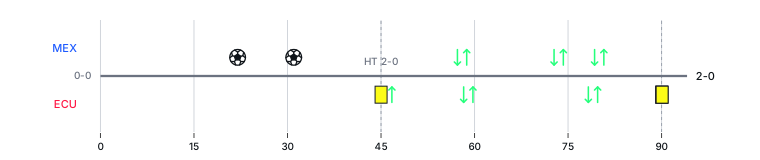
The two goals that followed confirmed the pattern. Quiñones finished at 22 minutes from an assisted sequence inside the box. Jiménez tucked in the second nine minutes later, again from an assisted situation, again from a position where the shot carried real weight. Mexico's match total landed around 1.0 xG against Ecuador's 0.73 — a meaningful edge, but the more telling gap is in goals: Mexico converted twice, Ecuador zero times. That is the arithmetic of the match.
Mexico did not need to control the half to shape it. With 43% of the ball and 15 total shots to Ecuador's 7, they ran more attacks into dangerous areas and finished two of them. The first-half double meant Ecuador spent the entire second period chasing a scoreline they never threatened seriously until a single moment in the 74th minute. The early direct attacks did not just produce goals; they fixed the terms of everything that came after.
Quiñones as Connector: Goal, Assist, and the Thread Between Them
A goal and an assist in the same first half already marks a player as central to the result. What makes Quiñones' contribution worth examining closely is that those two outputs required opposite things from him — and he delivered both inside nine minutes.
His goal at 22 minutes was the finisher version: arriving into an assisted situation and converting from inside the box. His assist nine minutes later flipped it — now he was the creator, finding Jiménez in the right moment for the second. In 80 minutes of action he completed 17 of 23 passes, added three key passes, won four duels, and made three ball recoveries. The influence record tags him as finisher, creator, defensive worker, and physical outlet — not decorative labels, but a description of where the match actually put him. He operated in multiple directions in the same game and the stat line reflects it.
The provider evaluation named him the match's standout performer with an 8.2 rating, and the case holds up without leaning on that number alone. No other player on either side combined a goal and an assist with three key passes. His involvement made Mexico's direct attacks feel connected rather than accidental — he was both the cue and the consequence in the sequences that decided the match. The limitation is honest: this is one game, 80 minutes, and a provider rating is context not proof. But within these 90 minutes, the stat record and the two decisive events point in the same direction.
Ecuador Kept the Ball — and Ran Out of Things to Do With It
Four hundred and seven passes at 83% accuracy is a lot of football. Ecuador's 57% possession share meant they spent more time with the ball than Mexico across every phase of the match. It produced one shot on target.
The numbers that explain it: seven shots total, 73 passes into the final third, 25 crosses attempted with three finding their target. Piero Hincapié played the full 90 minutes, attempted six crosses, and completed none accurately. Moisés Caicedo completed 57 of 64 passes and covered enormous ground — he even created Ecuador's one big chance of the match — but his expected assist contribution stayed fractional and that chance went unconverted. Ball circulation that reaches the final third consistently but cannot turn crossing volume into goal-mouth threat is possession without penetration.
Ecuador's 0.73 xG across seven shots is not nothing, and the wide delivery volume showed where they were trying to find openings. But the on-target count tells the starker story: Mexico's shape absorbed the deliveries, and the clearance count — 38 for Mexico against Ecuador's 21 — confirms where ball arrival was landing. Ecuador kept the ball. They did not make Mexico choose.
The Bench Changed the Window, Not the Finish Line
Ecuador's double change at halftime — Ángelo Preciado and Yaimar Medina on — made sense as a shape adjustment for a side chasing two goals. The five-minute window after those changes produced one shot worth around 0.03 xG. The fifteen-minute window looked no different. That is not a verdict on the decisions; it describes what the post-change output actually was.
The Kevin Rodríguez introduction at 59 minutes carried a different weight. He came on for Enner Valencia, and at the 74th minute he had Ecuador's clearest chance of the entire match: an assisted right-foot attempt from close range with an xG around 0.35 — the highest single-shot value either side generated outside Mexico's two converted finishes. He missed it. That moment captures Ecuador's second-half ceiling precisely: they finally arrived in the picture that could threaten Mexico's lead, and the execution did not match the position.
Timing a substitution effect is always a bounded read. Nothing here proves the changes caused the Rodríguez chance — they coincided with Ecuador's push to find a route back, and Rodríguez ended up in the right place at the right moment without finishing it. The bench changed the window. It did not change the scoreline.
Synthesis
The 2-0 scoreline tells the right story, but only if you read it through conversion rather than control. Mexico did not outrun Ecuador, outpass them, or crowd them off the ball. They outfinished them — and they did it in the first 31 minutes, before Ecuador's bench had a chance to change the picture.
Quiñones was the piece that made Mexico's directness repeatable rather than occasional. A goal at 22, an assist at 31, three key passes across 80 minutes — he was the player who recognized when to be the finisher and when to be the creator, sometimes within the same attacking sequence. That dual function is what separated Mexico's attack from Ecuador's broader possession work: not better structure in the abstract, but a player who read the cue correctly when it mattered.
Ecuador's possession numbers were real. The 57% share and 407 passes were not manufactured — they reflected genuine ball circulation across long stretches of the match. But Caicedo completing 57 passes and Hincapié delivering six crosses that none of them found a teammate accurately sums up the constraint: ball movement that never found the decisive pass is volume, not danger. Rodríguez's 0.35-xG miss at the 74th minute was Ecuador's best moment of the night, and it went wide. Mexico had found their two best moments nine minutes apart in the first half, with Quiñones in both frames, and finished them.