
The Left Flank Had a Governing Presence
Portugal's most productive footballer on the night was also their left back, which tells you something about where the real creative authority sat. Nuno Mendes occupied an advanced position down Portugal's left side for the full ninety minutes — not as a passenger holding width, but as a player who demanded the ball under pressure and did something useful with it. Four key passes, two big chances created, six crosses with four accurate, and an expected assists figure just above 0.5: those are not numbers that describe a defender fulfilling a modest secondary function.
The spatial picture explains how that output was possible. Portugal's outfield shape was crowded through the center — ten of sixteen average positions fell in the central lane — but the width Portugal actually carried came from their fullbacks pushing high on both sides. Mendes and Cancelo both registered average positions in the attacking half. The difference was what Mendes did with that occupation. Three of four dribbles completed, eight duels won, 89 touches: this was someone taking responsibility for Portugal's first dangerous route into the box, not someone simply standing in an advanced postcode.
Croatia had to accept that the left-channel delivery never really closed. Whether they could not suppress it or chose to concentrate their defensive effort elsewhere cannot be read from the record alone, but the consequence is plain enough: Portugal's clearest access point stayed open for the duration, which is a significant structural advantage even when the conversion does not follow immediately.
Croatia Had Forty Percent of the Ball and Four Big Chances
Forty percent possession, just 24 passes into the final third, 43 long balls, 22 crosses: Croatia's attacking shape had the character of a team that had accepted where the ball would mostly live and built around that reality. The result was a set of chances whose quality sat well above what the territory they occupied would typically produce. Four big chances from 13 shots is a ratio most sides with 60 percent possession would accept without complaint.
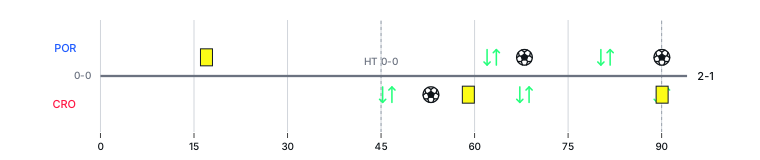
Ivan Perisic was the instrument through which that threat became actual. Seven crosses across the ninety minutes, five clearances in defense, and at the 53rd minute a left-footed goal that changed the match's terms: the conversion arrived from a position close to the six-yard area, the kind of location that emerges from sustained flank pressure rather than patient central buildup. Croatia also struck the woodwork, and three of their four big chances went unconverted. On a different night, those numbers describe a different result.
What made Croatia's profile genuinely awkward to manage was the efficiency of the construction. Twenty-four final-third passes is almost nothing over ninety minutes — yet they still manufactured four clear openings from inside the box. That is not the output of a side that was simply defending and hoping. Portugal needed to be precise without the ball at least as often as Croatia needed to be precise with it, and for a period after Perisic's goal, they were paying the cost of failing to be.
Three Changes at Sixty-Three, One Header at Ninety-Four
Trailing 1-0 after Perisic's 53rd-minute goal, Portugal waited roughly ten minutes before making three substitutions simultaneously. Francisco Conceição on for Pedro Neto, Nélson Semedo on for Bruno Fernandes, Gonçalo Ramos on for João Cancelo — three positions altered in a single move. What the substitution record cannot tell us is why those three players were chosen or whether specific weaknesses were being targeted. What it does show is what followed over the next half-hour.
Ramos entered as a different kind of box presence than Cancelo provided: two aerial duels won across his 27 minutes, a physical target rather than a ball-carrying fullback. Portugal generated shots in the post-substitution period, and the decisive one arrived deep in stoppage time. At 90+4, Ramos met a Rafael Leão delivery with a header from central position — a low pre-contact chance quality of around 0.07, but once on target the conversion probability was above 0.5, and he placed it cleanly. One goal, one shot on target, 19 touches: not an extravagant cameo, but an efficient one.
The sequence — changes at 63, winner at 90+4 — does not compress into a clean causal story. Twenty-seven minutes separated the substitutions from the decisive moment, and the match remained unsettled for most of that interval. What the record supports is narrower: Ramos was the player who scored, he arrived through those changes, and Portugal's attacking options were different with him in the side. Whether the shift in personnel created the conditions for the late header or simply coincided with it is a distinction the available evidence cannot close.
Synthesis
Portugal had the superior structural base. Mendes gave them a reliable access point that never closed — four key passes and two big chances generated from a full back position is the output of someone who understood the demands of the match and accepted responsibility for meeting them. That is not a small thing. The left side was Portugal's governing channel, and it governed for ninety minutes regardless of the score.
Croatia's answer was to make each touch count in the final third. With a third less possession and barely two dozen passes into Portugal's end, they still manufactured four clear openings through direct delivery and physical presence on the flanks. Perisic's 53rd-minute goal was the concrete cost of that exposure — not a fortunate deflection, but a properly constructed finish from close range. For thirty minutes Portugal chased a deficit their own flank control had done nothing to prevent.
The triple change at 63 minutes altered the personnel available without immediately settling the match. Ramos brought a different kind of target into the box, and the winner he scored at 90+4 required a header rather than a dribble — a different skill set from what Cancelo offered. Whether the changes created the chance or Leão's delivery created it regardless is not a question the record resolves. What the match leaves is this: Portugal's structural advantage through Mendes was real and sustained, Croatia's direct threat was real and dangerous, and it took until the final seconds for those two truths to find their resolution.