
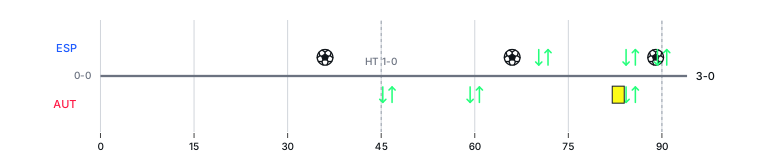
The Same Pass, the Same Run, Twice
Oyarzabal scored twice in this match, and both times the sequence started the same way: Cucurella high on the right flank, ball delivered inside, finisher already in the center channel. The cue was consistent. The recognition was consistent. And Austria never found an answer to it.
In the 36th minute, Cucurella picked up the ball wide right and fed Oyarzabal, who had pulled into the central lane between the lines. Spain went 1-0. Then at 89 minutes, with the game settled, Spain ran the same combination — Cucurella again, Oyarzabal again, same spatial logic. The pass found the same pocket. The goal made it 3-0. What makes this more than a coincidence is where both players sat across the full match: Cucurella advanced on the right, Oyarzabal parked centrally in the attacking half. The wide occupation kept the width, and the central position gave the finisher a consistent landing zone.
The mechanism is readable: Cucurella occupying the flank forced Austria's defensive shape to commit or concede width. When that commitment left a gap through the middle, Oyarzabal was already there. The delivery found a player in space that the defensive structure had effectively vacated. You cannot call it luck when the same situation resolves the same way across 53 minutes of football.
When the Right Side Serves the Left
The 66th-minute goal looked different on the surface — a headed finish, a different creator, a different scorer — but the underlying spacing problem for Austria was the same one. Baena had been pushing high on the right throughout his 71 minutes, and Porro was working the left channel from his own advanced position. At the moment Baena's delivery arrived, Porro was arriving unmarked at the near post. The header went in at an xG value of around 0.53 — a high-quality chance, not a scramble.
What that sequence tells you is that Spain's width was genuinely two-sided. Baena attempted seven crosses in the match, completing two. Those numbers are imprecise, but they describe a player pressing delivery options repeatedly from a high right position. Porro on the far side had averaged deep into the left channel all game. The cross found a runner who had the space because the defensive shape was pulled toward the ball-side. The cue was Baena's delivery; the recognition was Porro's timing into the header zone; the consequence was the cleanest chance of Spain's afternoon.
This sequence doesn't prove Spain was systematically exposing Austria's weak side across every phase of the game — it was one goal, one delivery, one run. But it confirms that the same spacing logic that powered the Cucurella-Oyarzabal corridor was available from the other flank as well. Wide occupation on one side creates the problem; width on both sides means there is nowhere safe to compress.
Cucurella's Role: More Than the Delivery Man
Two assists. Two key passes. Two big chances created. Cucurella completed 50 of 55 passes and touched the ball 75 times in 90 minutes — a distribution load that tells you he was not a fringe contributor floating wide and hoping. He was the engine of Spain's most productive attacking route.
What separates a wide player who generates chances from one who just crosses hopefully is whether the delivery actually forces a defensive decision. Cucurella's position high on the right — not tucked in, not dropping to receive — meant Austria had to account for him in space that should belong to an attacker. Both of his assisted goals came from that advanced zone: wide, direct, consequential. The fact that he also picked up four ball recoveries and an interception while playing that high suggests he was not simply parking himself forward and ignoring the rest of the pitch. He was covering both ends of the role.
The provider evaluation rated him among Spain's top performers on the night, and the stat line earns that reading. But the more precise point is this: Cucurella's creation output was not the product of volume — he attempted one cross all match, accurate. His two big chances came from quality decisions in the right moments. That is the difference between a wide player adding width and a wide player adding threat. His first touch gave Oyarzabal the pass. His positioning gave Spain the mechanism.
Synthesis
Three goals, two creators, two corridors — but one shared problem for Austria. Spain's attack kept finding the same structural opening: a wide player occupying a flank, a runner arriving into the space the defensive shape left uncovered, a delivery that arrived before the adjustment could be made. Cucurella and Oyarzabal ran it twice. Baena and Porro ran a version of it once from the opposite side. The scoreline read 3-0 and the mechanism behind it was the same each time.
What makes this match worth examining beyond the result is that Spain did not break Austria through an avalanche of possession or a reckless pressing game. The two Cucurella assists came from recognizable spacing — a wide player pushed high, a finisher in the central lane, a delivery that landed in a gap the defense had already conceded. The Baena-Porro goal confirmed the pattern was not a one-corridor accident: move the width to the right, and the left-side runner arrives at the far post into the same category of available space.
Cucurella's role sits at the center of it. Two big chances created, both converted, against a compact defensive block — that is not a player being given license to freelance. That is a player recognizing the moment when the structure offers the pass and executing it. Spain had the idea. The distances held. And the players found the cue each time it appeared.