
Bosnia's Ball Moved Around Their Midfielders, Not Through Them
The distribution burden in Bosnia's early buildup fell almost entirely on the back line. Center-back Tarik Muharemović finished the match with 105 touches and 83 passes — numbers that belong to a deep-lying organizer, not a central defender trying to spring attacks. Stjepan Radeljić added 79 touches and 63 passes from the same defensive position. Their midfield partners, by contrast, barely registered. Armin Gigović managed 13 touches and 10 passes in 51 minutes. Ivan Šunjić had 21 touches and 17 passes across the same window. Bosnia held 52 percent of the ball across the full match, but in those early phases, that possession lived at the back.
The consequence was predictable, if not always visible. When a team's central midfielders are not receiving the ball, they are also not passing it forward into dangerous territory. Bosnia's final-third entries were being sourced directly from deep, which compresses the options available and removes the middle layer that typically creates the timing and angles for penetration. Fifty-two passes reached the final third across the whole match — a figure that reflects how rarely Bosnia could circulate possession into advanced zones with real purpose.
This was not a question of effort or press resistance. Gigović won three aerial duels and made an interception; Šunjić made two tackles and recovered the ball. They were active. What the numbers say more plainly is that neither player was the route the ball wanted to take forward. A team can recycle possession all afternoon through its defensive line and still be avoiding the harder game.
Three Changes at 51 Minutes and the Route Forward Reopened
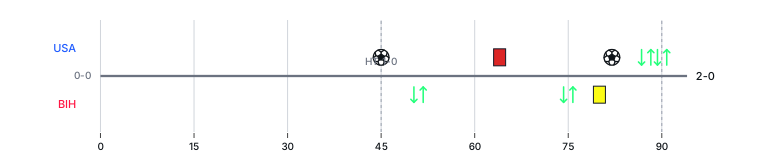
The triple substitution Bosnia made at the 51st minute was not subtle. Gigović and Šunjić came off together, replaced by Benjamin Tahirović and Esmir Bajraktarević. Edin Džeko also departed, with Ermin Mahmić arriving alongside them. The cumulative shift in midfield involvement over the following 39 minutes was significant enough to read as a structural repair, not just a personnel rotation.
Tahirović, in his 39 minutes on the pitch, recorded 44 touches and 42 passes — comparable total involvement to what Gigović and Šunjić produced combined across 51 minutes each. Bajraktarević added 28 touches, 21 passes, two key passes, and a shot on target in the same window. The incoming trio collectively gave Bosnia a functional middle layer: players willing to receive under pressure, move the ball forward, and operate in space that the starters had largely vacated. Within 15 minutes of the changes, Bosnia had generated two shots from that higher zone.
The limitation here is clear: timing does not prove causation. A substitution window shows what followed, not what the bench instructed. Mahmić, who replaced Džeko, had 20 touches but lost the ball nine times in his 39 minutes, which tempers any clean reading of the change as an unqualified success. Still, Tahirović and Bajraktarević reintroduced a progression layer that was simply absent from Bosnia's early play. The game became more accessible to them in the second half, and those two players were the reason.
Balogun's Red Card and the Defensive Responsibility USA Did Not Avoid
Folarin Balogun was dismissed for a foul in the 64th minute, and from that point the match presented USA with a different kind of problem. This was no longer about building or controlling — it was about absorbing. Bosnia had already improved their midfield access through the substitutions; now they had a numerical advantage to press with. The phase from the 61st to the 75th minute produced zero USA shots, three Bosnia shots, and a provider pressure signal that ran consistently negative throughout.
What USA's defense did in that window is worth examining plainly. Matthew Freese made three saves, all of them from inside the penalty box. Chris Richards won five aerial duels, made eight clearances, and blocked two shots. Tim Ream contributed six clearances and won his ground and aerial contests. Between them, these three players absorbed the portion of Bosnian pressure that translated into genuine attempts — and none of those attempts resulted in a goal. Bosnia's three shots in that phase carried very little combined threat, under 0.1 xG total, which suggests USA's positioning and pressure absorption kept the attempts to the periphery rather than the center.
The red card did not make USA's task comfortable, and it should not be described as planned. But what it did was clarify the demand: stay compact, protect the central channel, and deal with what arrives. Ream and Richards understood that demand. The defense showed that responsibility and emergency are not the same thing — that composure under a genuine constraint can be as meaningful as anything that precedes it.
Synthesis
Two separate problems ran through this match, and they belong to different teams at different moments. Bosnia's first problem was their own structure: a back line carrying distribution weight that should have been shared, midfielders present on the pitch but largely absent from the game. That is not a crisis of effort. It is a question of who accepted the responsibility to govern the middle of the pitch — and for the first 50 minutes, the answer from Gigović and Šunjić was conditional at best.
The repair they made at halftime was real. Tahirović and Bajraktarević gave the team a functioning progression layer in the second half, and Bosnia began to look like a side that understood how to use the ball rather than simply holding it. The problem is that by the time the repair was complete and pressure accumulated, Balogun's red card handed the match a new frame entirely.
USA's task from the 64th minute onward required a different kind of authority — not to impose the game, but to manage a sustained defensive burden with precision and without collapse. Richards and Ream provided that. Freese handled what reached him. The Bosnia pressure from the numerical advantage produced territory but not central access of real value.
What this match leaves is the distinction between a team that found its route late and a defense that held its line when holding was the only option available. Bosnia earned the better access. USA absorbed the consequences. The final accounting depends on which of those two realities you decide carried the match — and on this evidence, the cleaner answer is that USA's defensive composure, imposed by circumstance, proved more durable than Bosnia's improved midfield involvement, which arrived just late enough to run into a wall that was already set.