
The Spine That Wouldn't Stop Circulating
Argentina's possession didn't flow from flair — it flowed from two center-backs who refused to be idle. Cristian Romero completed 112 of 117 passes. Lisandro Martínez completed 117 of 120. Together across 120 minutes, they touched the ball 260 times and surrendered it a combined ten times. That is not two defenders occasionally joining the build; that is a circulation spine that the team's entire territorial logic depended on.
The structural consequence was predictable, in the best and most boring sense: 64% possession, 850 passes at over 91% accuracy, and 82 deliveries into the final third. When the ball keeps returning to two reliable central relays before being advanced, a team doesn't need improvisation to enter dangerous areas — it grinds there, pass by pass, until the shape has moved the pressure far enough up the pitch. Argentina never looked like a team that had lost the tempo.
What the buildup produced was volume. Twenty-two shots in 120 minutes, with roughly fifteen arriving from inside the box. Possession became territory, territory became position, position became attempts. Whether that constitutes sophisticated football or very expensive efficiency is a question of taste. It is, at minimum, coherent. Argentina did not wing this; they drilled through the same channel repeatedly and waited for the math to comply.
What a Circulation Spine Needs at the Other End
A possession structure has no meaning unless someone on the receiving end can do something with it. Argentina's entire central buildup had a destination, and the destination was Messi — operating in the central attacking zone where everything Romero and Lisandro were setting in motion eventually arrived.
The numbers make the argument clearly enough. Six shots on target. Four key passes. One big chance created. Five fouls drawn. An xG of around 1.3 on nine total attempts. In a team that produced 22 shots, one player generated more than a third of the expected goal value and nearly all of the genuine, high-probability threat. That is a load-bearing role, not a luxury. Being fouled five times across 120 minutes speaks to the difficulty Cabo Verde had handling him in those central areas — repeatedly found, regularly productive, awkward to manage without conceding contact.
He attempted nine crosses as well — not the profile of a wide player trying to deliver from the flank, but someone searching for the angles that his central positioning kept opening. Eighty-four touches, one goal, four key passages, and a drawn-foul rate that exceeded any other player on the pitch. The provider evaluation ranked him highest on the night, which the statistics justify independently — the ranking adds nothing the numbers don't already say more cleanly. Argentina moved the ball through their center-backs because doing so found Messi; Messi was in central attacking areas because that is where the ball kept arriving.
Vozinha and the Clearance Wall
Argentina's xG advantage over ninety minutes and extra time was 1.7. Their goal advantage was one. That gap has a name: Vozinha.
The Cabo Verde goalkeeper made eight saves — three from inside the box — and registered 12 ball recoveries across 120 minutes. Argentina outshot them 22 to 16 and generated big chances Cabo Verde never approached. Vozinha held the margin by intervening repeatedly at precisely the moments where probability most strongly favored Argentina. That is not a lucky night; that is a goalkeeper absorbing a workload that would split most matches open if he hesitated once.
Around him, the labor was equally relentless. Cabo Verde registered 26 clearances and blocked six shots. The defensive output — clearances, blocks, saves — describes a team spending the bulk of its energy inside its own penalty area, absorbing pressure rather than dispersing it. Whether that was a deliberate design or forced geography is something the numbers cannot settle, but the consequence is plain: it kept Cabo Verde competitive in a match that Argentina's underlying shot and chance profile said should have been decided before extra time.
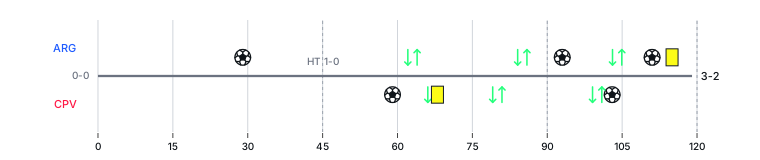
Cabo Verde finished with 0.45 xG and two goals — they overperformed their own attacking numbers dramatically. The scoreline was 3-2. A goalkeeper having a worse night, one fewer defender clearing in the right moment, and this article is a comfortable Argentine victory. It wasn't. That is worth saying plainly rather than letting the winner's profile swallow the story.
Synthesis
Argentina won because their central buildup was coherent, their possession was purposeful, and Messi remained a problem that 120 minutes of organized defending could not fully extinguish. Cabo Verde stayed in the match because their goalkeeper refused to make the margin comfortable, and the players working around him put 26 clearances and six blocked shots between Argentina's attempts and the net.
The interesting thing about this result is not the 3-2 — it is the distance between Argentina's process advantage and the single-goal margin they actually achieved. A team that circulates that precisely through two center-backs, that concentrates its entire attacking threat in one player who generated an xG of around 1.3 alone, that completes 850 passes and reaches the final third 82 times — that team should separate cleanly from a side with 0.45 xG. They didn't. Extra time, a narrow margin, Vozinha's eight saves standing between the scoreline and something far less flattering.
That is partly to Cabo Verde's credit. Their defensive work was not passive management; it was high-volume labor under sustained pressure, and Vozinha's contribution was the difference between a comfortable Argentine win and what actually happened. Football rarely rewards that kind of resistance with points, but it deserves to be read as resistance rather than merely insufficient attack. Good football and enough football are not always the same thing — and this match was a clean, if uncomfortable, illustration of the distance between them.