
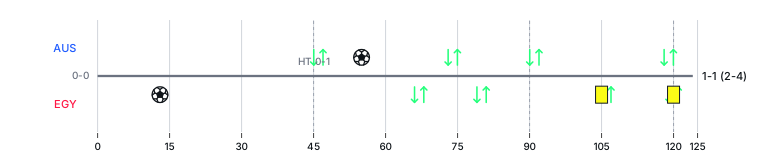
The Ball Always Came Back to Attia
Marwan Attia touched the ball 143 times and completed 96 of 117 passes. Those figures are not incidental — they are the readable trace of a team that routed almost everything through one position, a possession economy where the ball finds the same address repeatedly because the structure demands it.
What Attia's volume created was territorial persistence. Egypt held 58% of the ball, kept Australia in a sustained defensive posture for most of 120 minutes, and produced passing totals that kept the game's tempo on their terms. His influence across creator, distributor, and defensive roles ran wider than simple recycling, and his expected assists figure suggests he was occasionally threatening from deeper angles rather than just absorbing and redistributing. There were 23 long balls in his game, 10 of them finding a teammate — the range of his game was real, even if the exact passing chains are not fully traceable.
The honest limit of all that: aggregate touch and passing totals confirm a central, high-volume buildup base without showing where the ball went next or how often it reached dangerous territory. Egypt lived in the middle. Whether they used it well enough is the harder question — and the one Australia spent 120 minutes making more expensive to answer.
Australia Made Egypt Pay for Every Yard of Central Access
Jackson Irvine was rated the match's best player on the pitch and the stat sheet he built that on is not about creation. Seven clearances. Seven duels won. Two blocked shots. One hundred and twenty minutes without being replaced. That is the accounting record of a player asked to absorb a possession-dominant opponent and make arriving at the goal feel unreasonable.
His average position kept him centrally, roughly in the middle third — the zone Egypt most wanted to use. The combination of his clearance count and duel total across the full match tells you something concrete: Australia's defensive work was concentrated in the areas where Egypt's passes most frequently arrived. The structure held. Egypt, running 117 passes through the center and touching the ball more than any other team in that match, still reached three shots on target over two hours. That is the ceiling Irvine and Australia's shape imposed.
Whether that shape was coached as a deliberate low block or simply emerged from Australia conceding territory to protect the central zone, the record cannot say. What it can say is that the ceiling held. Irvine is the most legible face of why. His clearances and duel count represent a team willing to absorb pressure and make it cost nothing useful — and across 120 minutes, it cost Egypt almost exactly that.
The Lead Came from a Dead Ball, Not a Dismantled Shape
Emam Ashour's header in the 13th minute did not arrive through a buildup sequence that cut Australia open. It arrived from a corner — Karim Hafez's delivery finding Ashour close to goal, the contact generating a chance that carried roughly 0.26 xG. A well-struck header from that position tends to score. This one did.
The distinction worth pressing is what kind of lead Egypt had actually earned. In the opening phase, their two shots carried more combined chance value than Australia's three — so Egypt were not merely recycling possession without threat. But the goal itself did not come from central circulation flowing into open-play penetration. It came from a dead ball, a delivery, and a runner winning the aerial contest. Ashour's finish was precise. The mechanism that produced it was structural, not the product of Attia finding a gap in Australia's block.
For Australia, that distinction sharpens into something uncomfortable. They had been answering Egypt's central possession adequately from the first minute. Irvine's clearances and duels were already accumulating. But the set piece was a different problem — a different defensive requirement — and briefly, before the 13th minute was done, they had not solved it. Egypt led 1-0. The match had its first answer, and it had come from the route that neither team's open-play argument was actually built around.
The Equalizer Looked Familiar Because It Was
Mohamed Hany's equalizer in the 55th minute was also a headed set-piece finish. The symmetry is almost too convenient to ignore: the match's first goal, a corner header; the match's second goal, a corner header. Two teams that had spent 40-odd minutes effectively neutralizing each other's central structures both ended up scoring through the one mechanism their shapes had not been built around.
The score reset to 1-1 and the choice set for both sides changed immediately. Egypt, playing into a lead, had not needed to stretch or commit beyond their structure. Level, they were back to looking for something the previous 40 minutes had not shown them how to produce — a clean open-play chance against a defense that had already proven its compactness. Australia, no longer chasing, could settle back into the arrangement that had made Egypt's passing volume count for so little. The state from minute 55 through to extra time produced no goals from open play because both teams returned to doing what they had already shown they were good at.
The match's real open-play argument had essentially run its course before the hour mark. Both goals came from corners. The remaining hour-plus was a contest to see whether either side could achieve from open play what they had already failed to achieve — and neither could.
Six Shots After the 80th Minute, and the Cause Remains Genuinely Unclear
Egypt sent on Mahmoud Trézéguet at the 80th minute in place of Karim Hafez. The 15-minute window that followed produced six Egypt shots worth around 0.4 xG — their most concentrated attacking stretch of the second half, and a window in which Australia managed five shots worth just 0.16 xG. The imbalance was real.
Whether Trézéguet produced it is a different question. The substitution window does not record him as directly involved in the shots that followed his introduction. Egypt were already the possession-dominant side pressing as regulation time shortened, and game state itself generates urgency regardless of personnel. The substitution happened; the shot volume rose; the match went to extra time goalless. Both of those things are true simultaneously.
This is the honest shape of the late-game reading: Egypt generated more in the closing stretch, and a substitution happened just before it. Assigning causation would be tidy. It would also be wrong, or at least unsupported. What the evidence confirms is that Egypt's most dangerous late window — 6 shots, 0.4 xG — produced no goal. Which meant the match was going to extra time regardless of who was standing on the pitch when the whistle blew, and Trézéguet, whatever his contribution, could not change that particular arithmetic.
Australia Missed First and Never Recovered
Australia's first penalty missed. That single fact restructured the shootout before Egypt had put a single kick away.
Egypt were flawless: four attempts, four conversions. Australia scored their second and third kicks, but the first miss had already made each subsequent attempt an exercise in staying alive rather than applying symmetric pressure. By the time Australia's fourth taker stepped up with Egypt leading 3-2 on penalties, Egypt needed one more conversion. They had not missed yet. They did not miss then. Australia's fourth attempt missed, and Egypt advanced.
A 4-2 penalty result is not a complicated story, and it would be bad analysis to extract broad tactical conclusions from who converted under that specific pressure. Egypt went 4-for-4; Australia went 2-for-4. Those are the facts. The penalty record does not say one team played better football over 120 minutes — it says Egypt were more accurate when the tie came down to spot kicks. These are genuinely different measurements of different things. Irvine, who was rated the best player on the pitch across 120 minutes of actual football, converted his penalty and still went home. The format required one team to progress. The penalty contest provided the answer without particularly caring about what preceded it.
Synthesis
The match had a logic that the scoreline slightly obscures. Egypt circulated through Attia, Australia resisted through Irvine, and both teams scored from corners. The open-play argument — the one that all 143 of Attia's touches and all 7 of Irvine's clearances were supposedly conducting — ended at 0-0. Everything else needed a different mechanism to resolve it.
What emerges when you place the two threads side by side is not a failure on either side so much as a specific kind of equilibrium. Egypt had the possession base and the central volume. Australia had a defensive structure that turned that possession into something manageable rather than threatening. Neither side could use their strength to break the other's resistance through open play. Both sides found their only clean goals from dead balls. There is something almost aesthetically honest about that outcome: the football argument was a draw, and the corners confirmed it.
Jackson Irvine was the highest-rated player in this match and went home. Egypt, who had the ball more, were occasionally more threatening from set-piece deliveries, and then converted a perfect shootout, advanced instead. Whether Egypt played better football across 120 minutes is a question the match pleasingly refused to settle. Whether they advanced is not. Four penalties, four goals. That kind of execution does not require a taste judgment — it just requires the other team to miss twice.