
The Possession Stat Lied. The xG Split Did Not.
The final score was 2-0, and anyone who looked at Algeria's ball share and decided Switzerland were fortunate is confused about what football is attempting to accomplish. Switzerland finished with 2.56 in chance quality against Algeria's 0.73 — a gap of 1.83 that the scoreline arguably flatters the losing side. Eleven shots to eight, a three-shot edge, a big-chance count of two to one. Every directional signal points the same way.
That Algeria held 45 percent more ball than Switzerland is not in dispute. What is in dispute is what possession is worth when it does not move through the defensive structure it faces. Algeria's 84 percent pass accuracy and comfortable territory figures look composed on the surface. The chance quality says something different — specifically, that all that composure was being applied in the wrong direction, or in the right direction without the final idea needed to make it dangerous.
The result profile carries no exaggeration signal. None. This was not a match where an inferior team held on through saves and woodwork. Switzerland had the lead, the better chances, and the higher volume of inside-box attempts. Algeria's shot profile came out at roughly 0.09 per attempt. Switzerland's came out at more than three times that per shot. When the gap is that wide, calling it an efficient performance by the winner is not spin — it is just accurate.
One Fast Break, Ninety Minutes of Damage
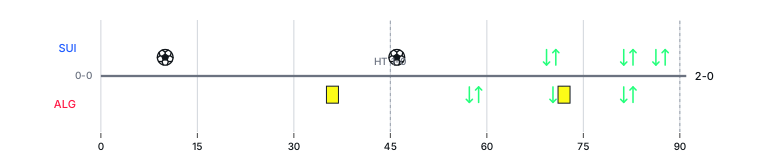
What made Breel Embolo's tenth-minute goal genuinely punishing was not that it arrived early — it was that it arrived with almost no margin for the goalkeeper. Assisted by Johan Manzambi and finished left-footed, the chance carried 0.97 in expected goals. That is near the ceiling for a non-penalty attempt. At that value, the finish is almost a formality; the work was already done in reaching the position.
Switzerland found that position through a fast break, catching Algeria's defensive shape before it could recover and compact. The significance of the transition tag is what it implies about the defensive exposure: Algeria were caught advancing, and the ball moved through that gap at speed. One move, inside ten minutes, worth more in chance value than Algeria managed across the full ninety. Switzerland's entire fast-break output for the match was that single sequence — but it carried 0.97 on its own.
The structural consequence is straightforward. A team chasing from the tenth minute against a compact, organized defensive block faces a fundamentally different problem than a team hunting an equalizer from 0-0. Algeria had to push possession higher and earlier, which created the conditions for Switzerland to defend deep and threaten again on the break. The opening goal did not just put Switzerland ahead — it shaped what every subsequent Algerian attacking decision had to contend with.
Possession Without Danger Is Just Expensive Bookkeeping
Fifty-five percent possession sounds like a team exerting pressure. Seventy-two passes into the final third sounds like sustained access. Then you arrive at the number that answers the question football actually poses: 0.73 in expected goals from eight shots. Roughly 0.09 per attempt. That ratio is not the mark of a team that was close. It is the mark of a team that was present in the right zone without being able to do the thing the zone exists for.
Three of Algeria's eight attempts were blocked before they reached the goalkeeper. Two were saved. Their single big chance went unconverted. The distribution of shots by outcome tells the same story as the xG total — this was volume without craft at the final step. Switzerland conceded territory and responded with 25 clearances and 16 interceptions, a defensive output consistent with a side choosing to absorb rather than contest possession in midfield, and structured well enough to prevent Algeria's entries from becoming genuine threats.
When 72 passes into the final third produce eight shots averaging 0.09 in expected quality, the question is not whether Algeria were unfortunate. The question is what they were doing with the space they occupied. A final-third pass is only meaningful if it moves the ball somewhere the defense cannot comfortably handle. These mostly did not. Algeria's possession was real; their control of what possession is supposed to produce was not.
The Late Surge That Ended in Rieder's Left Foot
Switzerland introduced Fabian Rieder and Noah Okafor at the seventieth minute, and the closing phase became noticeably sharper. In the window from the 76th minute through added time, Switzerland produced four shots worth a combined 0.85 in expected goals. Algeria, over the same stretch, managed two shots worth less than 0.05. The imbalance in that final quarter was stark.
The substitutions preceded the surge in sequence; whether they caused it is a different question and one the available record cannot answer. What the record does show is the output: Switzerland pressing for a third goal, Algeria largely passive, the match's balance of attacking intent fully inverted from what the first-half possession figures suggested.
The complication is Rieder. At the 81st minute, he found himself inside the box with a left-foot attempt that carried 0.67 in expected goals — the second-highest single chance value in the entire match, trailing only Embolo's opener. He missed. That is a serious opportunity. Switzerland had the 2-0 lead and the chance to make the evening unambiguous; instead the scoreline stayed where it was. The final number was accurate, but it was also conservative. A match where Switzerland generated 2.56 in chance quality and finished with two goals is a match where the conversion did just enough, and one where a sharper late phase could have made the contest look even more one-sided than the xG already did.
Synthesis
The tempting interpretation is that Algeria were unlucky — more ball, more entries, more industry in the final third, undone by Swiss efficiency and an early goal they had no business conceding. That reading collapses the moment you apply the numbers. Algeria's 72 final-third passes produced eight shots at 0.09 apiece. Switzerland's 36 produced 2.56 across eleven attempts. The gap is not marginal fortune. It is a structural difference in what each team did when they arrived at the point where football becomes dangerous.
Embolo's fast break in the tenth minute is the match's clearest single statement: one transition, properly executed, worth nearly a full goal in expected value before Algeria had time to set. Everything that followed — Algeria's accumulated possession, the late Swiss pressure, Rieder's unconverted big chance — adds texture without changing the verdict. Switzerland created better, defended well enough, and converted what was necessary.
Algeria had the ball. Switzerland had the result and most of the chances to make it larger. When those two things diverge this sharply, the possession figure deserves exactly one function: context. Not proof of quality, not evidence of misfortune, not a claim on a better outcome. Algeria moved the ball with composure through areas where composure alone does not score. Switzerland moved it less often and far more purposefully. The xG split of 2.56 to 0.73 is not a harsh reading of this match. It is the honest one.