
The Grass Canada Left Behind
The decisive damage in this match did not come from sustained pressure or elaborate combination play. It came from the space Canada kept offering every time they pushed men forward — open, uncontested ground that Morocco ran into with economy and ambition.
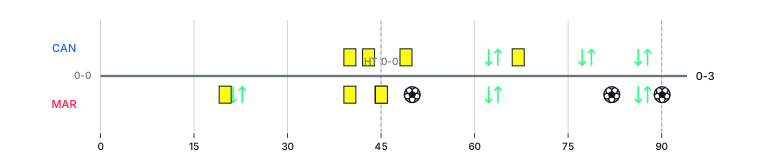
Morocco produced three fast-break shots across the ninety minutes. Two of them were goals. Together those three attempts generated roughly 0.7 in shot value, meaning the actual outcomes barely outpaced what the chances were already worth. That is not luck dressed up as efficiency — that is a team that found good positions and finished from them. The contrast with Canada's transition output is almost uncomfortably direct: one fast-break shot, essentially no chance value, no goal. Morocco turned open grass into two-thirds of the final scoreline; Canada turned open grass into a footnote.
This matters because the match surface reading — Canada active, Canada earning dead balls, Canada pressing — suggests a closer contest than the one that actually occurred. Activity is not the same as threat. Canada generated the kind of busyness that fills a match report without filling a net. Morocco, whenever space appeared behind Canada's advancing shape, filled it with something that counted. The mechanism was not mysterious. It was ruthless against a team that kept supplying the conditions for it.
Eleven Corners, Decorated Nothing
Canada earned eleven corners. Eleven. In the logic of certain football observers, that means Canada were dangerous, dominant at the flag, worthy of credit for persistence. In the logic of what actually happened, it means Canada delivered eleven opportunities to produce exactly zero goals from set-piece situations.
Four of those corners generated shots. Jonathan David's attempt in the fifth minute was saved. Alistair Johnston headed one that was blocked at 18 minutes. Tani Oluwaseyi headed another wide at 35 minutes. Then, four minutes into the second half, Luc De Fougerolles shot right-footed from what looked like the best position of the lot — at 49 minutes — and missed. The combined shot value across all four was barely a quarter of a goal. None of them were close to going in. Each individual attempt stayed low in chance quality because the shots were the product of set-piece scramble rather than clean delivery into dangerous space.
None of this proves the deliveries were poorly designed. What it proves is simpler and less flattering: the volume produced nothing, and treating eleven corners as evidence of attacking quality is the kind of stat-comfort that gets teams embarrassed by the scoreline. Canada had the ball in Morocco's half enough times to feel good about themselves. Morocco had it in Canada's for long enough to win 3-0.
Ounahi's Two Shots Were Worth More Than Canada's Eleven Corners
Azzedine Ounahi finished this match with two goals from two shots on target. Both shots found the net. Both were right-footed. The first came at 50 minutes from a set-piece situation; the second, the more consequential one, arrived at 82 minutes from a fast break — the situation that defined Morocco's whole approach.
What makes the stat line interesting is what sits underneath it. Ounahi played 87 minutes, touched the ball 65 times, completed 33 of 42 passes, attempted three dribbles and completed two, and won six individual duels. He was not a penalty-box cameo or a finishing specialist inserted for the final ten minutes. He was a midfielder doing midfielder work across most of the contest — and then converting the two moments when the match opened up in Morocco's favor. Two shots, two goals, around 0.23 in combined chance value. He outperformed the probability without needing volume to do it.
The taste judgment here is worth making plainly. Ounahi's two goals were not fortunate finishes from a player simply standing in the right place. They required someone with the composure to finish under match pressure from positions that were good but not obvious. He was the player Morocco needed at the sharp end of the transitions that broke Canada's back. Midfielders who can do that without needing ten chances are genuinely rare, and this match was a clean illustration of why.
Díaz and the Art of the Final Pass
Brahim Díaz played the full ninety minutes and touched the ball 32 times. From those 32 touches he produced 19 passes, and from those 19 passes he produced two assists and two big chances created. That ratio is not an accident — it is a player who understood precisely when to release the ball and where to put it.
Both assists came late. The first, at 82 minutes, found Ounahi for the second goal — a fast-break sequence that Canada could not interrupt. The second, deep in stoppage time, set up Soufiane Rahimi for the third, killing whatever residual belief Canada had managed to preserve. Two passes, two goals scored, the match sealed on both occasions by the same creator.
What Díaz did that Canada could not answer was simpler than the tactical vocabulary usually applied to it. He found the pass when Canada's structure was most exposed — after Morocco absorbed pressure and the moment to go vertical arrived — and he put it in the right place without hesitation. Canada, by contrast, spent the match doing volume work at dead balls that required more players in Morocco's box, which meant fewer players available to stop the ball when Morocco broke. Díaz did not exploit a sophisticated weakness. He exploited the straightforward cost of a team that kept advancing without solving what happened when they lost it.
Synthesis
There are two ways to watch this match and reach the wrong conclusion. The first is to see Canada's corner count and territorial presence and decide they were unlucky. The second is to see the 3-0 scoreline and decide Morocco were dominant from the first whistle. Neither is accurate, and both miss what the match was actually arguing.
Canada had volume. Morocco had value. Eleven corners generating barely a quarter of a goal across four shots is a set-piece program that decorated the match without threatening it. Three fast breaks generating two goals is a conversion rate that makes the scoreline look almost fair. The gap between those two outputs is not a story about effort or desire — it is a story about where the quality of moments lived, and it lived entirely on one side.
Ounahi and Díaz made that concrete. A midfielder who scores twice from two shots in 87 minutes, doing the full physical work of the role between those moments, is not a beneficiary of good fortune — he is the end product of a team that knew how to move the ball into space and had someone capable of finishing when it mattered. Díaz supplied the final pass on both late goals from a passing volume that most creative players would consider a quiet afternoon. Together they represent exactly the kind of football that rewards judgment over activity.
Canada played enough to feel they were in the match. Morocco played well enough to make that feeling irrelevant. That is not pedantry — it is the difference between a process that works and a process that merely looks like one.