
Six Minutes From Change to Goal
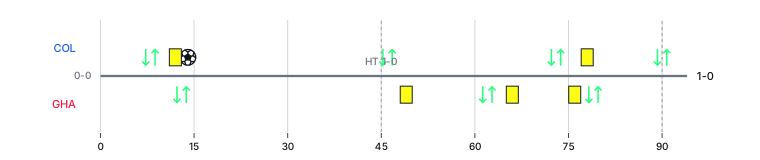
Before Colombia had found any rhythm, they had already lost their starting striker and scored the only goal of the match. Jhon Córdoba came off in the 8th minute — the kind of early exit that usually unsettles a team's structure — and Luis Javier Suárez stepped in. What happened next was either fortunate sequencing or a rapid adjustment that immediately bore fruit: Suárez provided the assist for Jhon Arias's goal at the 14th minute, and Colombia led 1-0 with the match barely started.
The six-minute gap between substitution and goal is striking precisely because it compresses the usual logic of squad disruption. A forced change in the first quarter-hour typically costs teams their attacking shape before they find a replacement rhythm. Here, the 15-minute window after Suárez's introduction produced three Colombia shots and nearly 0.8 of an expected goal — including the goal itself. Suárez was directly involved in those key moments as the provider.
The honest boundary is that timing cannot prove the substitution caused the goal. Arias might have scored regardless; the move might have been disruptive in ways the shot count does not capture. What the record does show is that Colombia absorbed the loss of their original center forward, introduced a replacement inside ten minutes, and immediately threatened — not despite the change, but through it. That is the structural fact the scoreline sits on.
Puerta and the Weight of the Middle
A team that loses its starter before the tenth minute needs someone to hold the shape together through ninety. Gustavo Puerta did exactly that, and the numbers behind his performance make the case without embellishment: 78 touches, 59 completed passes from 62 attempts, two key passes, and one big chance created. For a central midfielder playing the full match, that is not a quiet efficiency line — it is the load-bearing output of a player through whom most of Colombia's buildup moved.
The quality embedded in those numbers matters as much as the volume. Completing 95 percent of attempted passes in a match where Colombia were protecting a lead and frequently moving through congested central space is a different kind of achievement than recycling the ball safely in open territory. Puerta's two key passes and his big chance created show that the distribution was not just possession management — it carried genuine forward threat. His expected assists figure of 0.22 across the match reflects a consistent intention to break lines rather than merely circulate.
Puerta was rated Colombia's top performer on the night by the provider's own evaluation, though that ranking means most when it is grounded in what he actually did rather than taken as a standalone verdict. Here, the stat line earns the rating. The early substitution changed Colombia's forward structure; Puerta kept the connecting tissue of the midfield intact through everything that followed.
Ghana's Attack Never Found the Door
There is a version of this match where Ghana's defensive resilience — seven saves, 11 clearances, constant pressure absorption — becomes the headline. That reading has merit. But it obscures something worth naming directly: Ghana did not just fail to score, they failed to build a credible attacking platform at any point. Eight shots, zero on target, 0.26 in expected goals from the entire game. Five of those eight attempts were blocked before they reached the goalkeeper. Their two shots from inside the box represent the extent of genuine danger they produced.
The shot distribution makes the picture clearer. Ghana's best attacking phase by xG came between the 31st and 45th minute, where they accumulated roughly 0.15 of expected goals — still a modest total, and still producing nothing on target. The majority of their attempts came from outside the box, where value is inherently low. They had 39 percent of possession and sent 52 passes into the final third, but final-third entry and final-third conversion are different problems, and Ghana solved neither.
This is not a story about a team that tried and was denied by heroic defending. Colombia's goalkeeper was not called upon to make a single save in regulation. Ghana's attack did not press against a locked door — it largely failed to reach it. The gap between the two teams' chance profiles was fundamental, not marginal, and it is what makes the 1-0 scoreline look like a narrow Colombia win when the underlying shape was considerably more one-sided.
Eleven Shots in Fifteen Minutes
The final fifteen minutes added a layer to the process gap that the scoreline still does not fully reflect. Between the 76th minute and full time, Colombia produced 11 shots worth nearly a full expected goal — 0.95 — while Ghana generated nothing. Zero shots, zero xG in a closing window when a trailing team typically commits forward. Ghana's defense was absorbing, not attacking; Colombia's attack was pressing, not protecting.
That late surge came on top of a Colombia shot profile that already showed 21 attempts and 2.5 expected goals across the whole match. The closing burst alone was nearly worth a goal in isolation, and Ghana's goalkeeper and defensive line held. Whether those chances were cleanly converted or well-saved is a different question from whether the chance creation was real — at 0.95 in fifteen minutes, the pressure was genuine even if the finishing was not.
The scoreline stayed 1-0. The late shot flood did not produce a second goal, and it would be wrong to read Colombia's total as proof they should have won by three or four. But it does confirm that the 1-0 was not a product of Colombia sitting on a fragile lead and surviving — they kept creating, kept forcing Ghana deeper, and finished the match as the side controlling both the ball and the territory that matters. The narrow margin was real. The process gap underneath it was not narrow at all.
Synthesis
Put these four threads together and the 1-0 reads like a scoreline that understates what actually happened. An unplanned early substitution produced the match's decisive action within six minutes. The midfielder who held Colombia's center together through ninety minutes did so with a volume and accuracy that kept the team's structure coherent long after the forward line had been reshuffled. Ghana never mounted a credible reply — not because Colombia's defense was pressed into heroics, but because Ghana's attack never generated the kind of chances that require heroics. And in the closing quarter, Colombia came at Ghana with eleven more shots without converting, leaving the margin technically unchanged but the underlying process emphatically clear.
What the match exposes is a team whose system held under an early shock rather than fracturing. The Córdoba exit in the eighth minute was the kind of event that tests whether a squad's roles are coherent enough to absorb disruption — and Colombia's were. Suárez slotted in, Puerta kept distributing, Arias scored. The late surge confirmed that the process did not fade once the lead was secure.
Ghana's seven saves from their goalkeeper deserve acknowledgment for what they were: a genuine defensive effort that kept a modest chance profile from becoming an embarrassing margin. But a team that produces zero shots on target across ninety minutes is not a team that was unlucky. They were outplayed from the front to the back of the pitch, and a 1-0 final score is the most charitable version of that reality.