
The Ball Lived in France's Possession. The Danger Did Not.
Seventy-six percent possession is not a performance. It is a condition — a description of who held the ball, not what they built with it. France completed 568 passes at nearly 90% accuracy and delivered 87 into the final third, which is how a side maintains territorial pressure without necessarily manufacturing alarm. The ball circulated. The box remained largely untroubled.
The structure of that passing tells you where France's attacks were terminating. Twelve corners. Twenty-three crosses, one of them accurate. Ten of fifteen shots launched from outside the penalty area. What France controlled was the perimeter — the space around danger rather than inside it. Each time the ball reached the final third, it encountered a shape designed to absorb exactly that kind of approach. The 87 final-third passes produced activity and volume; they did not produce the kind of central access that forces a goalkeeper to make difficult decisions.
France did not play badly, exactly. They pressed, recycled, sustained possession in areas that should theoretically yield something. But against a side willing to surrender the ball and hold its shape, passing fluency has a ceiling — and that ceiling was visible long before the final whistle. Territory only matters if you can convert it into decisions the opponent cannot handle. For most of this match, France could not.
Seven Players in the Center Lane Is Not an Accident
Seven of Paraguay's fifteen players averaged in the center lane. Twelve of fifteen averaged in their own defensive half. Whatever the specific instruction from the bench — and average positions cannot tell you that — the shape that emerges is coherent and deliberate in its effect: a layered central mass that made clean entry into the penalty area consistently difficult.
This is where Paraguay deserves more analytical credit than a side conceding 76% of the ball typically receives. Accepting territorial inferiority carries a cost: you surrender corners, invite crosses, cede the midfield entirely. Paraguay paid all of those costs and held the line anyway. France had twelve corners and produced almost nothing from them. Their crossing volume was high and their accuracy close to zero, which is the predictable outcome when the penalty area is staffed specifically to prevent clean deliveries from finding anyone. Crosses into crowds are not chances; they are recycled possession.
The deep center concentration did not prove a fixed defensive line or a pressed shape at specific heights — that is more than the spatial record can show — but the picture is clear enough. Paraguay identified France's delivery and crossing as the most manageable threat, positioned itself to absorb it, and managed. France's 568 passes found every corner of the pitch except the one that mattered. Paraguay allowed one clean open-play chance across 90 minutes. That is a bet that paid.
One Shot in Seventeen Carried Any Real Weight
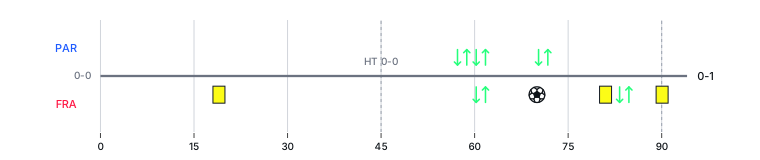
Mbappé's 70th-minute penalty was the one shot in this match that carried genuine conviction — a chance value around 0.79, converted as expected, and alone accounting for more than half of France's entire shot quality across 90 minutes. Everything else: sixteen attempts averaging close to 0.04 apiece. Four blocked. Seven missing the target. Five on target from open play, most handled without incident.
The distribution maps where France's attacks were dying. Ten shots from outside the penalty area, five from inside it — and of those interior attempts, the clearest open-play opportunity went unscored. Three shots from corner situations contributed almost nothing to the quality picture. The mix describes a team generating volume on the perimeter and finding the penalty area too congested to attack cleanly in the way that produces chances a goalkeeper fears. Twenty-three crosses to produce one accurate delivery; that is not a width advantage being exploited, that is width being neutralized.
France had two big chances all match. One became a goal; the other was wasted. For a side that monopolized possession this completely, two genuine opportunities represent a narrow attacking ceiling — not incompetence, but a real structural constraint on how much danger their territorial control actually generated. When the winning margin comes from a spot kick rather than sustained open-play pressure, the gap between possession and threat is not a matter of bad luck. It is the gap.
Doué's Quarter-Hour Was the Only Interesting Football in the Match
Désiré Doué came on in the 61st minute and France spent the next fifteen minutes generating more attacking value than they had managed in the preceding hour. Two shots, a combined chance quality around 0.81, one goal — France's highest xG window of the entire match. Whether Doué caused that burst, coincided with it, or arrived at exactly the moment when an hour of accumulated possession pressure was beginning to thin Paraguay's block, the record cannot establish. The cluster is real; the cause is open.
Doué's individual numbers from his 40 minutes suggest a precise and active presence: 17 of 18 passes completed, three key passes, two dribbles finished from four attempts, four duels won. He operated on the right side and offered France a more direct progression option in a lane that had been largely ornamental for most of the first half and opening exchanges of the second. Whether that directness unlocked the attack or simply decorated a window that was opening anyway, this match cannot say with confidence.
What it can say is structural: France's best fifteen minutes arrived after Doué's introduction, and in a game where the open-play shot profile was this thin, that window stands apart from everything around it. One substitution, one shifted texture, one goal — and then the match was over. The gap between that fifteen-minute output and the preceding 60 says as much about France's open-play limitations as any of the crossing numbers. They needed something different. For one brief window, they found it.
Synthesis
France won. The territorial control was genuine, the passing volume was real, and Mbappé scored his penalty without drama. None of that needs revision. What also happened is that France spent 90 minutes demonstrating the precise distance between holding a ball and knowing what to do with it when the opponent declines to come and take it back.
Paraguay's compact, centrally crowded shape transformed France's 568 passes into a largely self-contained loop — fluent, accurate, and tactically inconsequential for most of the match. The one accurate cross from twenty-three attempts is the cleanest summary available: France understood they needed to deliver into the box, went wide repeatedly, and found every delivery absorbed. The shot profile confirms it. Sixteen low-value attempts scattered around the penalty area, one penalty, two big chances from 90 minutes of possession dominance.
The Doué window matters because it names what France spent the rest of the match failing to find. Fifteen minutes, three key passes, a different tempo on the right — and France suddenly looked like a team asking a question the block hadn't fully prepared for. Whether that was Doué, fatigue in Paraguay's shape, or both at once, the evidence leaves room for all of it.
Winning with one idea — a penalty — against a side that invited no other kind of danger is a result, not a method. Paraguay held a better-equipped side to a spot kick and nearly escaped with something. France should find that at least mildly instructive about what their possession actually costs a well-organized opponent.