
The Scoreline Norway Didn't Deserve — and Took Anyway
Brazil arrived with fourteen shots, five big chances, and enough shot quality to expect at least two goals. They scored one. That gap between what the home side built and what the scoreboard paid out is the real subject of this match — not Norway's 2-1 win, which makes the evening sound neater than it was.
The numbers don't hide: 2.75 xG against one goal scored, a conversion rate barely above 7%, four big chances missed, a ball off the woodwork. Ten of Brazil's fourteen shots came from inside the box. Norway's goalkeeper made four saves. None of that translated into a second goal for the home side. Norway, by contrast, gathered 0.84 xG across nine shots and left with two goals to their name. The xG gap ran nearly two full goals in Brazil's direction. The scoreline faced the opposite way.
This kind of result does not mean Brazil played well. It means they built a more dangerous attacking output and were taxed for failing to convert it. Norway won the parts that count — the final third of each possession, the two moments that became goals. Brazil won almost everything else, and received the result those almost-everythings tend to earn. The scoreline exaggerates Norway's night. That is a fact, not a consolation.
Haaland's Economy Was Obscene
The reason Norway converted where Brazil didn't fits in a single stat line: two goals, three shots on target, thirty touches. Erling Haaland scored twice from chances that totaled roughly 0.4 xG combined — not a generous allocation — and still contributed two key passes in a match where he barely touched the ball by possession standards. Thirteen total passes. Two goals. That economy is the whole story.
What makes it worth stating plainly is the contrast it draws. Norway had nine shots total. Haaland turned two of them into goals from chance value that most finishers would leave on the pitch. He won four aerial duels, engaged across those thirty touches, and found the right positions without needing to own large stretches of possession to make himself decisive.
There is a version of analysis that calls this 'clinical' until the word means nothing at all. What it actually describes here is a finisher operating at several multiples of his expected output while Brazil's attackers — carrying far more collective chance quality across ninety minutes — failed to manage that trick even once. Norway had the better finisher. That is not a tactical observation. It is a simple and damning arithmetic fact, and it is the single most honest explanation for why the scoreline reads the way it does.
The Halftime Change That Actually Mattered
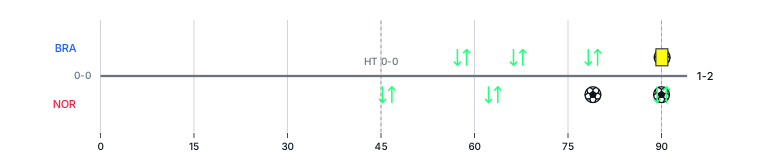
Norway went into the break goalless. The scoreline read 0-0 and the match was still open. Andreas Schjelderup entered for Antonio Nusa at 46 minutes, alongside Oscar Bobb replacing Alexander Sørloth. The more consequential of the two changes was Schjelderup, and the second half confirmed it quickly enough.
Both Norway goals went through him. He assisted Haaland at 79 minutes, opening the scoring at 0-1. He assisted again at 90 minutes, making it 0-2. Brazil pulled one back to make the final 2-1, but by that point the match was decided. Schjelderup played 45 minutes off the bench and directly created every goal Norway scored.
The substitution window cannot explain why the change was made — that is private context the match record does not contain. What it records is the sequence: Schjelderup on, two assists, two Haaland goals, match over. That is not a story about managerial vision or halftime inspiration. It is a direct, observable chain of events. The player who was not on the pitch when the second half started ended it as the decisive creative force. That fact stands regardless of how you read the intention behind it.
Brazil Still Found the Open Field
Brazil's conversion failure did not mean they ran out of danger. It meant they ran out of goals. The distinction matters, and Endrick illustrated it precisely.
He came on at 58 minutes for Matheus Cunha and within seconds had found himself at the end of a fast-break chance worth 0.67 xG — a high-value opportunity by any reasonable measure. A left-foot shot in the 59th minute that did not go in. In the five minutes following his introduction, Brazil put three shots worth 0.77 xG combined on the board without converting any of them. The fast-break miss was the clearest single compression of Brazil's whole evening: the opening was real, the finish was not.
The pattern fits the match's structural logic. Norway's possession share kept Brazil from sustaining prolonged pressure in the final third, but it also left space available when possession turned over quickly. Brazil found those transitions. Endrick, in 32 minutes and nine touches, found the biggest one. The chance was there. Norway's backline had a genuine problem in that moment. The fact that a high-value fast-break shot still did not go in says everything about the night Brazil were having — and nothing flattering about what might have been.
Norway's Possession Hub Was the Quieter Base
While Brazil was missing big chances, Norway was running the match's operational backbone with minimal drama and almost no mistakes. Sander Berge completed 117 of 119 passes, touched the ball 130 times, and lost possession three times across ninety minutes. Martin Ødegaard completed 101 of 109 and clocked 124 touches. Between them they produced a circulation hub so efficient that Norway finished with 66% of the ball — not because Brazil was passive, but because the Berge-Ødegaard axis kept producing the pass that kept possession alive.
Berge operated in a deeper position, making himself the primary link in Norway's ball retention. Ødegaard connected higher up, linking midfield to the attacking third — one shot on target, one big chance missed himself — while still sustaining a passing volume that kept the game on Norway's terms for long stretches. Neither scored, neither assisted. Both shaped the tempo without drawing attention to themselves for doing it.
The straightforward dismissal of this as possession without purpose misses something real. Norway's 66% ball share left Brazil with limited time in the game's more open, vertical phases — the kind Endrick's fast-break chance briefly showed was available when the match did stretch. The circulation kept those moments rare. That is the quieter structural half of why the scoreline reads the way it does: Berge and Ødegaard made the rhythm hard to disrupt, even if they never quite found the chance to break the game open themselves.
Synthesis
The scoreline says Norway won 2-1. That is accurate, and it is also where the comfortable reading stops.
Brazil built the better attacking performance across ninety minutes by almost every measure that precedes goals: fourteen shots to nine, 2.75 xG to 0.84, five big chances to three. They hit the woodwork. They missed four big chances. They generated a fast-break chance worth 0.67 xG late in the second half and did not score from it either. The home side's conversion rate sat below 8% from shot value that should have produced considerably more. The winner's negative xG margin is not a rounding error — it is the central fact of the match.
Norway had Berge and Ødegaard keeping possession circulating and tempo controlled — not brilliantly, not in a way that created clear chances in great numbers, but in a way that reduced the windows where Brazil's transition threat could breathe. And when that structure needed changing, Schjelderup came on and assisted both goals in 45 minutes. Haaland scored twice from roughly 0.4 xG combined.
Brazil built more. Norway finished better. The gap between those two things is where this match lived, and it deserves more than a shrug. Process without conversion is a philosophical argument. Haaland's second goal at 90 minutes is a scoreline. Football, irritatingly, continues to reward the latter.