
Two Minutes Did Most of the Work
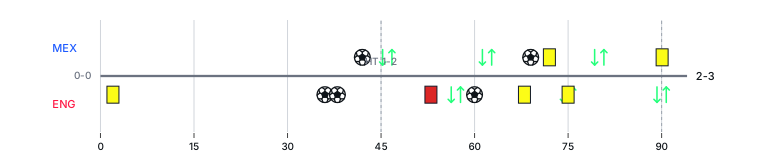
Jude Bellingham scored twice in 120 seconds — 36th minute, 38th minute — from three shots on target against 0.67 expected goals. You can call that efficiency. You can also call it the match's entire decisive argument, compressed into a pair of actions that Mexico never answered.
The first came off a Bukayo Saka assist. The second from a Harry Kane lay-off. Neither required elaborate construction — what made them the match's defining fact was the conversion return. Three shots on target, two goals, a lead that absent catastrophe was probably enough. England's remaining attacking output could have been near zero and the scoreline might not have changed. That is not a compliment to England's system. It is a precise description of what Bellingham did with the openings he was given.
He also won ten duels, completed four of seven dribbles, made four clearances, and recovered three balls across 103 minutes. The provider's man-of-the-match call is vendor opinion, and under normal circumstances I note it and move on. Here it agrees with the numbers: no one else on the pitch put that combination of finishing precision and defensive contribution into ninety-plus minutes. His 0.67 expected goals became two actual ones. That gap is the cleanest football argument of the evening — and, if we are being honest about what England built, almost the only one.
The Red Card Changed the Job Description
Jarell Quansah's dismissal at the 53rd minute did not change the scoreline — England led 2-1 at that moment — but it changed the brief entirely. A team cashing first-half chances with precision became, immediately and necessarily, a team whose only remaining task was keeping what it had. Those are different jobs, and the match pivoted on one foul.
Four minutes later, John Stones came on for Bukayo Saka. You read that substitution in a single look: a center-back replacing a wide attacker, after losing your actual center-back, while protecting a one-goal lead. England were reorganizing to absorb rather than extend.
What followed was better than it had any right to be. Kane's goal at the 60th minute — converted from a high-value chance while Stones was barely settled into the shape — pushed the score to 3-1 and created the cushion the defensive reorganization was going to need. In the phase from the 46th to the 60th minute, England still generated 0.84 expected goals from two attempts while Mexico managed just 0.03 from theirs. The structural cost of going to ten men was real. For a critical window, it was also deferred — and the timing of that deferral was the second-most important thing that happened in this match.
Twenty-Two Shots, Two Goals, One Honest Ledger
From the 76th minute to the final whistle, with England at ten men and protecting 3-2, Mexico put up 11 shots. They generated 0.72 expected goals from that barrage. They scored zero.
The full-game picture is marginally more flattering: 22 shots worth just over 2.0 expected goals, with two goals converting. They were not toothless. But the shape of their attempt distribution tells a harder story — seven blocked, ten missing the target, three saved across the full match. Two converted. That ratio describes a team generating volume from positions that did not consistently carry decisive value, not a team denied by misfortune or desperate last-ditch defending.
The late siege in particular — 11 shots, no goals — was the clearest illustration of the gap between Mexico's attacking ambition and attacking precision. A numerical advantage for better than thirty minutes. Sustained pressure in the closing quarter-hour. A combined return of 0.72 expected goals from those 11 attempts that produced nothing. Volume is not the same as threat. Football does not pay for quantity alone, and the final phase here is the record of exactly that. Calling England's survival fortunate would require ignoring what Mexico's shot profile actually shows.
Kane Was Both Roles in Eighteen Touches
Harry Kane played 90 minutes, touched the ball 18 times, and contributed directly to two of England's three goals. That sounds peripheral until you examine what those 18 touches produced.
The assist came at 38 minutes — the lay-off that released Bellingham for England's second goal, carrying 0.67 in expected assists. The goal arrived at 60 minutes from a high-value chance, Kane's only shot on target converting cleanly. Nine passes attempted, nine accurate. One big chance created. He gave nothing away.
Reducing Kane to the 60th-minute goal alone would be as wrong as inflating him into England's entire attacking identity. He did not dominate possession — 18 touches in 90 minutes is a deliberately limited footprint — but his return on those touches was precise where Bellingham's was explosive. The assist identified a real opening; the goal extended the lead at the exact moment England needed breathing room after losing a defender. A player who contributes at both ends of the chance ledger in fewer than twenty touches is not a passenger. He is, in this context, the most efficient use of scarcity on the pitch — which is something rather different from being indispensable.
Synthesis
England won 3-2 and never deserved to control this match. Mexico had more possession, more shots, more expected goals, and a numerical edge for close to forty minutes. The scoreline is honest about the goals scored; it says nothing about who held the territory or what that territory was worth.
What decided things was concentration. Bellingham scored twice in two minutes on 0.67 expected goals. Kane added a goal and an assist across 18 touches. That is not a system performing — it is two players converting the value they were given rather than needing more of it. England's remaining attacking contribution after the 40th minute was thin enough to be a footnote.
The Quansah red card remains the match's structural rupture. It turned England from a finishing team into a survival team, removed their most direct wide threat in Saka, and handed Mexico the numerical leverage that produced a real second goal and the closing barrage. England absorbed all of it. Worth recording. But calling it comfortable would require ignoring Mexico's second goal, eleven late shots, and everything in between. What England produced was a precise win built on individual conversion. What they then had to do was defend it honestly for forty minutes. They managed both. That is a result, not a performance — and the difference between those two words is exactly where this match lives.