
Six Minutes, One Touch, and the Only Goal That Mattered
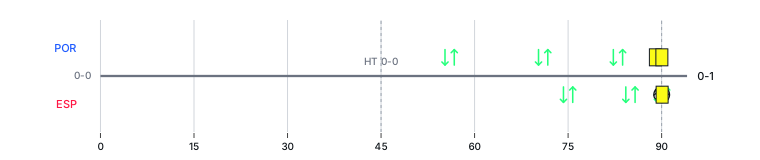
Mikel Merino entered in the 85th minute. He scored in the 90th plus one. Eight touches, four completed passes, one shot — and the shot carried a chance value of 0.55, meaning he found a genuinely dangerous position inside the box rather than simply getting lucky with a speculative strike. That is not a cameo. That is someone arriving at precisely the right moment and doing exactly the right thing with it.
The sequence traces directly: Ferran Torres came on at 75' for Alex Baena, and it was Torres who delivered the assist for Merino's left-footed finish. Two substitutes constructing the decisive goal in stoppage time. In the 15-minute window after Torres's introduction, Spain generated over 0.6 in chance value and scored once. In the five-minute window after the 85' double change — Merino on for Dani Olmo, Fabián Ruiz on for Pedri — Spain produced one shot, one goal. The numbers collapse the gap between sequence and outcome.
What the record cannot tell you is whether any of this was drawn up before kick-off. Substitution timing proves sequence, not intent, and it would be dishonest to dress this up as a rehearsed tactical masterstroke. What it does prove is that the two players brought on in the final quarter-hour were the two players who scored the only goal of the match, and that Merino's chance was not a desperate long shot but a well-located left-footed finish inside the box. Call it fortune if you like. The coordinates disagree.
Spain Were Already Making Portugal Uncomfortable Before Anyone Touched a Substitution Board
The late drama should not bury what happened in the opening quarter-hour, because the opening quarter-hour is what made the late drama structurally sensible. Spain's three fast-break shots in that window carried 0.74 in total chance value — more threat than most teams generate through sustained possession pressure across an entire half. Portugal, in the same window, produced three shots worth barely 0.06. That gap is not a rounding error.
The clearest moment came at the eighth minute: Mikel Oyarzabal received in transition and hit a left-footed fast-break attempt worth 0.61 — the highest single-shot value of the entire match, including Merino's winner. He missed. That is the most important sentence in the match's early story, because if Oyarzabal converts, Spain wins at 1-0 before the tenth minute and this is a different article entirely. Instead the game stayed level and Portugal were allowed to believe the first-half ledger was closer than it was.
At 16 minutes, Alex Baena and Lamine Yamal each forced saves from fast-break positions. Three transition shots in 16 minutes, all finding dangerous locations, none converted. Spain's early problem was not creating — it was finishing. The transition threat was real; the conversion was not. That gap between the quality Spain built and the scoreline they carried into the second half is precisely why the bench sequence at the end needed to happen, and why it made sense when it did.
Rodri Does Not Need to Be Spectacular to Be Irreplaceable
There is a type of midfielder who makes football writers reach for adjectives, and there is a type who makes football work. Rodri, in this match, was emphatically the second type — and the gap between those two categories is exactly where most punditry fails him.
He completed 87 of 93 passes and registered 106 touches across 90 minutes. His average position sat centrally in the attacking half, meaning Spain's circulation ran through him further up the pitch than a deep-lying pivot would typically sit. For a team finishing with 55% possession and 531 passes, Rodri was not merely a safety valve — he was the primary relay station. Seven ball recoveries alongside those passing numbers says something about how much defensive responsibility he absorbed simultaneously. The picture is of a player who stabilized two phases of the game at once without doing anything the crowd would clip for social media.
The honest limit here: average position is not a tracking map, and the record does not show which opponents he faced in those central zones or how his passes were directed. What it does show is volume, accuracy, and a spatial occupancy that placed him in the center of Spain's attacking structure rather than behind it. A team that wants to threaten in transition — as Spain's early shot profile confirms they did — needs someone to hold the shape when the ball is won. Rodri's numbers suggest he was that person, whether anyone applauded him for it or not.
Synthesis
Here is what actually happened, stripped of the stoppage-time romance: Spain created the better chances early, failed to convert the best one, and carried an undeserved 0-0 into the final stages. The bench then delivered what the starting eleven could not — a goal, and a good one, worth more than half a chance unit at a position inside the box. Merino did not rescue a poor performance. He concluded a productive one that had simply refused to finish its own sentences until minute 90 plus one.
Rodri is the reason Spain's possession did not decay into sterile lateral passing while the game stayed level. Ninety minutes, centrally positioned, absorbing contact, recycling the ball with near-perfect accuracy — that is not glamour, but it is the infrastructure on which transitions get launched and substitutes arrive in useful positions rather than desperate ones. The early fast-break shots did not materialize from nothing. They emerged from a team that kept its shape and its composure in possession even when the scoreline lied about who was controlling the match.
You can tell the story as a substitute scoring a dramatic late winner and you would not be wrong. You would just be missing the part that made the substitute's arrival mean something. Bad teams also make late substitutions. The difference is they arrive into matches they have already lost structurally. Spain's bench closed a match Spain had spent 90 minutes preparing to win — and Merino's left foot was the punctuation mark on an argument that had been building since the eighth minute.