
Ziko and the Transition Problem Argentina Could Not Absorb
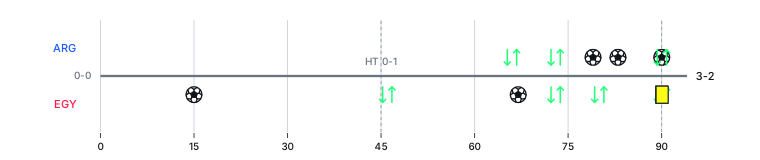
Egypt did not need the ball to damage Argentina. Their two goals came from exactly two fast-break situations, both finished by Mostafa Ziko, and together those chances carried just over 1.1 in combined shot value — not the kind of number that forgives defensive errors lightly. The first arrived at 58 minutes: Ziko on his left foot from close range, a chance worth about 0.5. High quality. The second came nine minutes later, right-footed, placed centrally and rated even higher at around 0.64. Two runs, two finishes, a 2-0 lead built without any sustained possession phase.
What makes that output structurally notable is how concentrated it was. Egypt converted both of their fast-break attempts. The full recovery sequence behind each break is not reconstructed in the record, so exactly what Argentina's defensive shape looked like in those moments stays unclear. But the consequence is plain: by the 68th minute, Argentina were two goals down against a side that had shown it needed very little space to punish them.
That is the structural asymmetry the rest of the match had to resolve. Egypt's transition threat was not high-volume — it was high-value. Two chances worth roughly 0.5 and 0.64 apiece, both converted by the same player. That kind of efficiency from a direct, vertical approach creates a specific problem: Argentina had to chase a match against a side that had already demonstrated it could score again on a single run into space.
Three Changes, One Attacking Window
Argentina's response came through the bench. At 66 minutes, two substitutions arrived simultaneously: Nicolás González replaced Nicolás Tagliafico on the left, and Lautaro Martínez came on for Rodrigo De Paul in midfield. Seven minutes later, Gonzalo Montiel replaced Nahuel Molina on the right. Three players reshaped the attacking profile across a roughly ten-minute window while the scoreline still read 0-2.
What followed is where the timing becomes worth examining. In the fifteen minutes after the 66th-minute pair of changes, Argentina generated five shots worth about 0.71 and scored once. In the fifteen minutes after Montiel's arrival at 73, the output climbed to seven shots worth just over 1.0, including two goals. Lautaro Martínez assisted the match-winner in stoppage time. Montiel's window directly included a goal. The correlation between the changes and the attacking surge is visible in the numbers.
That word — correlation — is doing real work here. The record shows what happened after the changes landed, not what instructions the incoming players carried or exactly which qualities shifted Argentina's shape. It is possible that score pressure alone was already forcing them higher and committing more bodies forward; it is possible the new arrivals brought movement that stretched Egypt's defensive block. What can be said cleanly is that the attacking surge that produced three goals opened after these substitutions, and that Martínez and Montiel were directly involved in the decisive moments. The shift was real. Its precise cause sits inside a decision the match record cannot decode.
Thirteen Minutes, Three Score States
Argentina were still 0-2 down at 68 minutes. They pulled one back by 79. Level at 83. Ahead at 90+2, when Enzo Fernández finished a Lautaro Martínez assist to make it 3-2. Three goals across three distinct score states, compressed into the final quarter of the match.
Each phase tells a slightly different story about the pressure Argentina generated. From 68 to 79, still two goals in arrears, they put up five shots worth around 0.71 and scored once — a conversion under maximum urgency with the deficit still intact. From 80 to 83, trailing by one, three shots and 0.36 total produced the equalizer. From 84 to stoppage time, now level, one shot worth about 0.21 and the winner. The chance quality per goal actually compressed as the match went on — Fernández's winner converted a moderate-value opportunity to settle it.
For Egypt, each score-state shift changed what the match demanded from their end. A two-goal lead with twenty minutes remaining is a fundamentally different problem than a one-goal lead, and a one-goal lead is different from level. In the final phase, Egypt's output fell to two attempts worth about 0.12 — absorbing rather than extending. The record documents a decisive imbalance: six Argentina shots worth nearly 1.0 in the closing window versus two Egypt attempts worth a fraction of that, and three goals against none.
Synthesis
The result looks dramatic. The underlying logic is more contained than the scoreline suggests. Egypt found two fast-break openings, Ziko finished both with clinical precision, and by the 68th minute a side that had generated almost nothing in sustained possession had a two-goal lead. Argentina had a transition exposure problem the match record documents clearly, even if the full defensive sequence behind each break is not reconstructable.
What the final scoreline adds is a second mechanism that ran parallel and then overtook the first. Argentina's bench arrivals coincided with a three-goal window playing out in stages: one goal while still two down, one to level, one to win. The players who came on were directly involved in the comeback's decisive moments. Whether the substitutions drove the swing, or whether score pressure had already pushed Argentina into maximum-commitment mode before the new arrivals reinforced it, the record cannot settle. The output was real; the causation is genuinely open.
What ties the two threads together is that they operated on the same match clock without canceling each other out. Egypt's transition threat was most potent while the game remained open — while Argentina were pressing forward and space existed to exploit. As the deficit closed and the late phase narrowed Egypt's shot volume to two low-value attempts, the match's shape had already changed. The same score-state logic that made Ziko's runs dangerous was the logic Argentina spent thirteen minutes reversing. Neither mechanism explains the other. Together, they explain the match.