
626 Passes and Almost Nothing to Show for It
Switzerland had the ball. They were very careful with it. Across 120 minutes they completed 626 passes at 87 percent accuracy and arrived at exactly 7 shots worth 0.35 xG. That is not possession as a weapon. That is possession as a comfort blanket.
The shape of that failure has a name: center-back buildup that never found a way through. Manuel Akanji and Nico Elvedi combined for over 200 passes between them, operating deep and central, recycling possession horizontally while Colombia organized to deny the line-breaking routes forward. The final-third pass share — 65 passes out of 626 — tells the story with clinical simplicity. Switzerland moved the ball through zones where Colombia did not mind it going. Striker Breel Embolo finished 87 minutes with 28 touches. A striker with 28 touches in a team that completed 626 passes is not a striker being served. He is furniture.
This is the part where someone will say Switzerland were pragmatic, that keeping the ball is itself a form of control. Sure. Keeping possession is also what you do when you have no better idea. The Swiss had the ball because they could not do anything dangerous with it, not because they were imposing a coherent attacking design. Zero big chances created across the entire match — regulation and extra time combined. The possession was the point, which is the problem.
Quintero Came On and the Game Had a Pulse
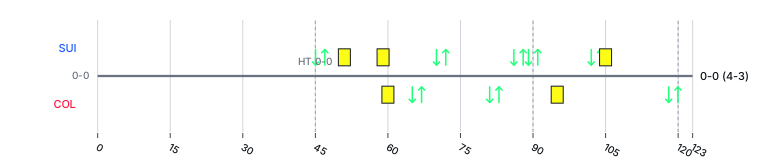
Juan Fernando Quintero entered at the 66th minute for James Rodríguez, and the match's creative center of gravity shifted. In 54 minutes he produced 2 key passes, 0.44 expected assists, one big chance created, and five crosses — three of them accurate. That is not a cameo. That is a player who made half a match feel like his.
What his numbers describe is a different kind of creative threat than Colombia had been generating before his arrival: advanced passing options, delivery from range, a willingness to find teammates in positions that demanded something from Switzerland's back line. His expected assists figure — nearly half a goal's worth of created danger in under an hour — puts him well ahead of anything the Swiss managed from any player across the full 120 minutes. Akanji's expected assists were 0.018. Elvedi's were 0.005. Quintero in 54 minutes: 0.44. The comparison is almost rude.
The substitution timing does not prove a strategic masterstroke — the five- and fifteen-minute windows immediately after the change produced zero shots, which is worth remembering. But what Quintero did across the remainder of the contest is not coincidence dressed up as analysis. The creative options available to Colombia after his arrival were demonstrably sharper than what had existed before, and the match's chance profile in extra time would reflect that.
The Extra-Time Surge Was Real
The extra-time shot map does not invite ambiguity. In the first additional period, Colombia produced 5 shots worth 0.28 xG while Switzerland managed zero — not one attempt, not one shot, zero expected goals. The second period was sharper still: Colombia generated 3 more shots worth 0.35 xG against Switzerland's single low-quality effort at 0.05. Across both extra-time phases combined, Colombia put 8 shots on the board worth 0.63 xG. Switzerland contributed 1.
This matters because it contradicts the dominant possession reading. Switzerland had the ball more across 120 minutes, but in the thirty minutes where the match was actually being decided, Colombia was the side asking questions. Their top three shots by chance value all came from these final phases. The xG concentration in extra time represents Colombia's clearest window to win the match outright — and it coincided with the period when Quintero was most involved.
The phase data shows the output; it does not supply the mechanism with certainty. What caused the surge — personnel changes, match state, opposition shape — cannot be read cleanly from shot counts alone. What it does show is that the match's attacking balance inverted precisely when the scoreline most demanded a decision. That Colombia then lost on penalties is a fact. That Switzerland were the more threatening side in extra time is not.
Synthesis
There are two football matches inside this result. The first belongs to Switzerland: careful, central, voluminous, and almost entirely without danger. Six hundred and twenty-six passes and seven shots is not a tactical identity. It is the shape of a team that confuses possession retention with attacking intent, and succeeds at exactly one of those things.
The second match belongs to the final thirty minutes, where Colombia's creative shift produced the sharper chance profile across extra time and still left without the result. Quintero's numbers in under an hour were not incidental decoration — they represented the only substantial creative threat either side produced across the full contest. Colombia finished with 15 shots and just over a goal's worth of expected value against Switzerland's 7 shots at a third of one.
Switzerland advanced, and they were the better-organized side for long stretches of regulation. But the match's most interesting football — the clearest chances, the most dangerous passages, the only player whose numbers suggested genuine incision — belonged to the losing team. The scoreline will say Switzerland. The football said something more complicated, and in extra time, something rather close to the opposite. They won, yes. So does bad architecture: it also stands.