
De Ketelaere Made the Center of the Pitch Very Expensive
There is a kind of forward who accumulates touches, runs the channels decoratively, and finishes the match having looked busy without costing anyone anything. Charles De Ketelaere is not that forward. In 67 minutes against the USA he scored twice, assisted once, and placed three shots on target — not from volume, but from the specific, punishing kind of positioning that makes a defense choose between bad options.
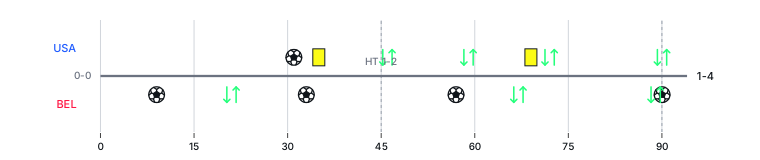
The first goal came at nine minutes, a right-footed finish from close range with an xG close to 0.9 — the sort of chance that is engineered rather than stumbled into. The second arrived at 33 minutes, a header that carried an xG around 0.3, which is not an easy header; it is a well-timed one. He then turned provider, threading the assist for Vanaken's 57th-minute goal before his afternoon was done. Two goals and a creative contribution, all from central positions, all from a player working within Belgium's attacking structure rather than decorating its edges.
The USA's defensive unit could not consistently limit his access to the spaces between their lines. That much the shot locations confirm. What it produced was a first half in which Belgium went into the break with a lead built on genuine central penetration, not set-piece fortune or goalkeeping errors. De Ketelaere was the clearest proof that Belgium's attack did not need to own the ball — it needed one player capable of making each touch count, and it had exactly that player.
Vanaken Entered and Belgium Did Not Notice the Difference — Which Is the Point
At 21 minutes, with Belgium already a goal up, Amadou Onana came off and Hans Vanaken came on. A first-half substitution at 1-0 is the kind of moment that invites speculation about necessity or panic — but that speculation is not the interesting part. The interesting part is what happened next.
Vanaken did not disrupt Belgium's attacking note. He extended it. The 15-minute window after his introduction included De Ketelaere's second goal, which arrived at 33 minutes. Then at 57 minutes, with the score at 1-2 from the USA's perspective, Vanaken received from De Ketelaere and finished — a goal converted from an xG around 0.08, which is the kind of shot you score when you are moving correctly and your technique does not desert you under pressure. At 90-plus three, he provided the assist for Lukaku's fourth, completing a one-goal, one-assist return across roughly 70 minutes of contribution.
The continuity matters more than the substitution itself. Belgium's attacking structure did not require re-calibration after the change; it required someone prepared to occupy the same vertical spaces and connect with the same delivery patterns. Vanaken was that person. Whether the change was forced or chosen is a question the record cannot answer and the scoreline does not require. What the record shows is that Belgium's central attacking threat survived the personnel shift essentially intact — a one-goal, one-assist return from a player who entered cold inside the first half is not an accident of timing. It is a player functioning within a coherent system.
What the USA's Possession Actually Bought Them
The USA held 56% of the ball and passed it 527 times. Belgium passed it 410 times. If you are the kind of analyst who uses possession as a proxy for intent, ambition, or control, this match will confuse you, and that is your problem rather than the match's.
Belgium finished with 15 shots, four big chances, and 2.15 xG. They scored four goals. The USA's shot volume was higher — 23 attempts — but their xG was nearly a point and a half lower, their big chance count was zero, and the goalkeeper they forced into action on the Belgian side made one save all match. One. USA's possession was real; its productive consequence was not. Their passes went sideways and backward in proportions that kept the ball away from Belgium without creating anything that actually threatened to change the score.
This is the possession illusion at its most instructive: a team can retain the ball, manage territory, and construct the visual grammar of control while the underlying chance quality tells an entirely different story. Belgium's 44% share was not a flaw in their performance — it was a feature of a team that moved vertically when they had the ball rather than moving horizontally to keep it. Four big chances against none is not a marginal statistical edge; it is an attacking profile that earned the result. The 3-goal winning margin exceeded what the xG alone would predict, but the underlying picture — big chances, shot location, goalkeeper workload — pointed toward Belgium throughout. The scoreline was not a fabrication. It was a consequence.
Synthesis
Belgium did not win this match despite having less possession. They won it because their attack was built around players who understood what to do when possession arrived, and those players happened to be very good at it in this particular game.
De Ketelaere gave the central lane a cost before halftime — two goals, three shots on target, positioning that asked the USA's defenders to solve a problem they couldn't consistently solve. When he came off at 67 minutes, the damage was structural rather than personal: Belgium's 3-1 lead was already a product of central penetration that Vanaken then maintained, adding his goal and his assist across the remaining minutes with the quiet efficiency of a player who does not need introducing to the role.
There will be people who note Belgium's possession deficit and reach for an explanation involving defensive shape, territory ceded, or an American team that controlled the tempo. They are welcome to that reading. It is wrong. Teams that control the tempo do not concede four big chances to none. Teams that defend their way through 56% of the ball do not end the match having forced the opponent's goalkeeper into one save. Belgium's profile in this game was not the product of defensive accident — it was an attacking team that converted its opportunities at a rate the USA could not approach.
The result profile carries one honest complication: the goal margin outran what the xG strictly predicted. Conversion fluctuates, and Belgium's four goals from 2.15 xG reflects a clinical evening rather than guaranteed repeatability. But the underlying picture — the big chances, the shot locations, the goalkeeper's near-idleness — was one-sided enough that the scoreline insults no one. Belgium played less, scored more, and the men at the center of it were precise where the USA was decorative. That is not pragmatism. That is taste.